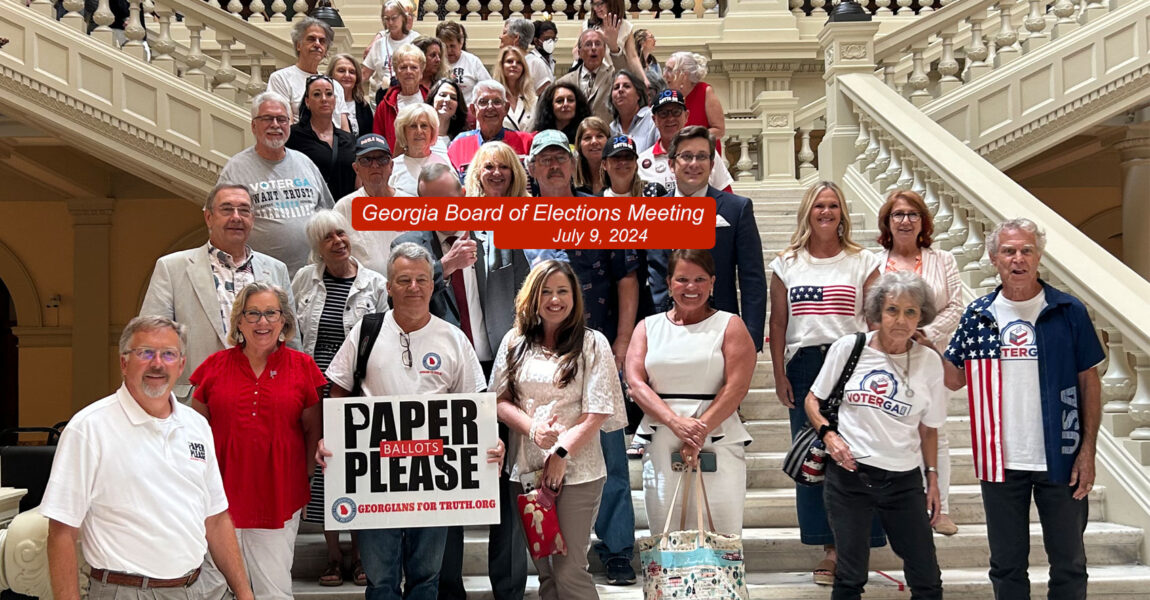
Atlanta, GA — GRA members from across the state and other election integrity proponents gathered at the State Capitol Tuesday morning for the State Board of Elections Meeting where cases, public comments, and proposed rule changes were examined. It was also the first meeting where Janelle King, newly appointed from the Georgia House of Representatives, joined the Board, which seems to have had a positive impact. King recently replaced registered lobbyist Ed Lindsey.
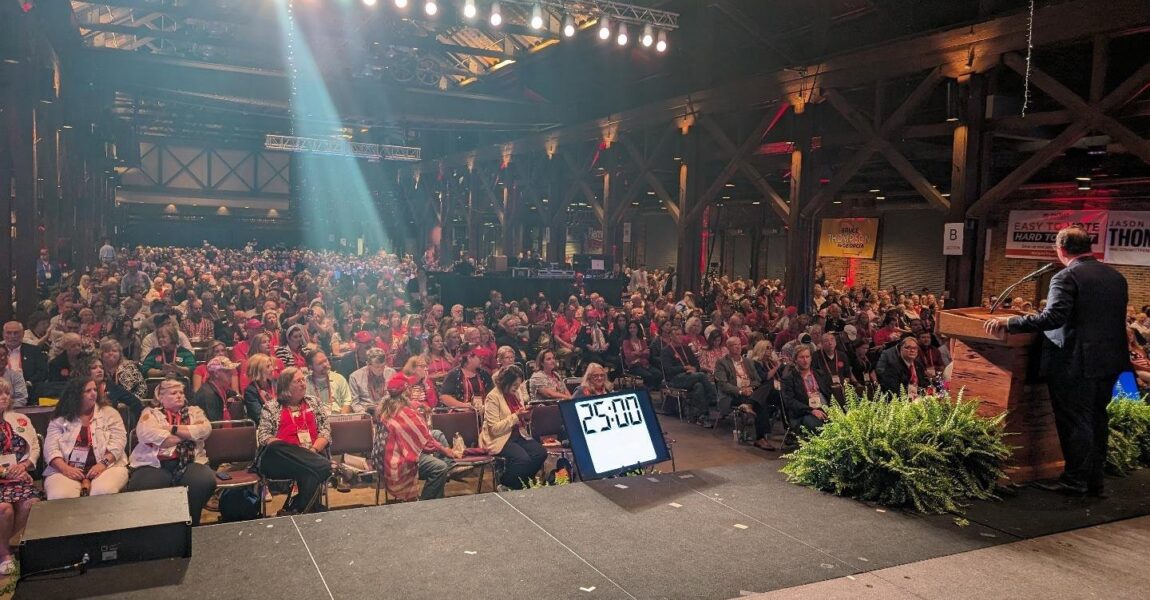
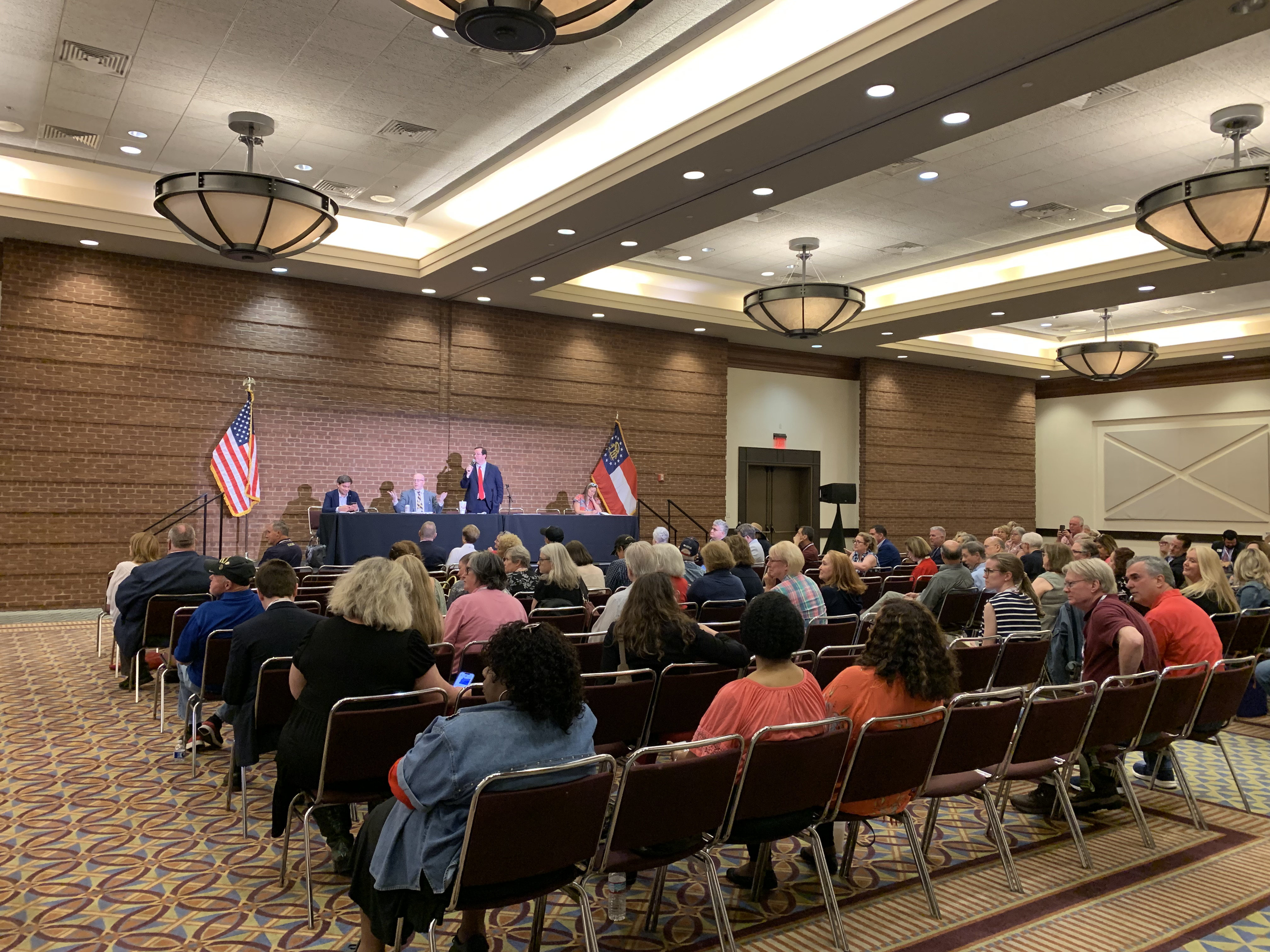
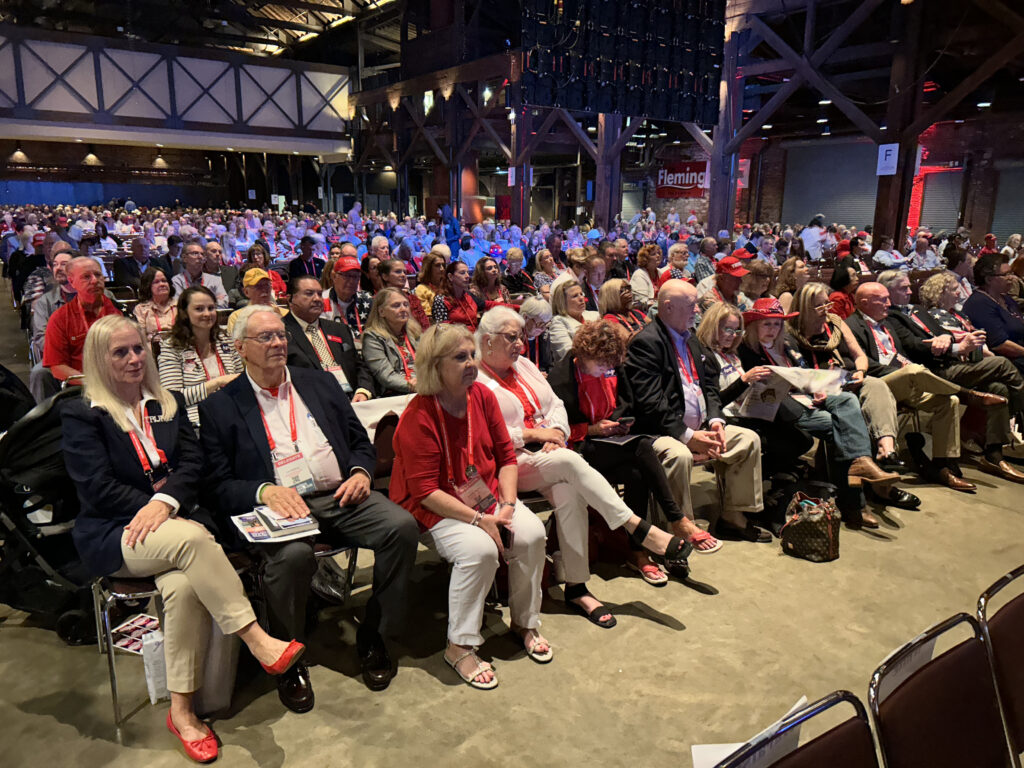
An estimated 255 patriots attended, requiring the Board to open two overflow rooms.
Dr. Janice Johnston came into the meeting swinging from the very beginning, making a motion to revisit the Rossi case. The Chair held that motion out of order, and Dr. Johnston immediately appealed the decision of the Chair. That led to the Board going into executive session to deliberate. When the Board came back into the public forum, Rick Jeffares joined with the Democrat-appointed member of the state Board and the Governor’s appointed member Chairman John Fervier to block the effort. Off to that rocky start, things began to get better as the day progressed.
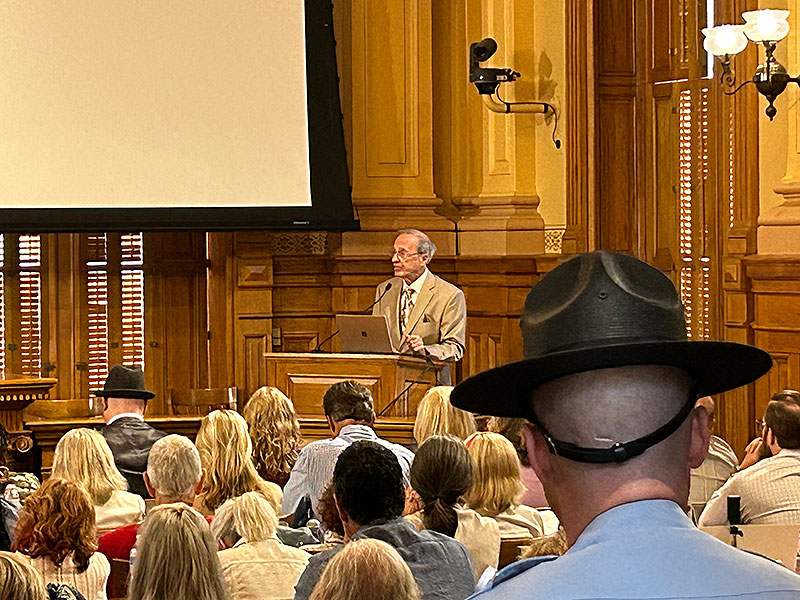
Garland Favarito was given 15 minutes to expound on concerns related to the Rossi case, such as, thousands of missing ballot images, ballots that appear to have been counted twice, and Fulton County’s unwillingness to comply with Open Records Requests to examine the actual ballots. He graciously and succinctly laid out a persuasive case for the Board and then introduced other elections experts who would also testify to the problems. According to expert computer technician Patrick Parikh, there is a loss of “SHA files” related to the meta-data in the Dominion voting machines that make them dubious and vulnerable to hacking.
Garland Favorito testifies
The public comments were overwhelmingly favorable to election integrity. Over 50 people had signed up for public comment at two minutes each. Sam Carnline, Jason Frazier, and Matt Rowenczak were among them. GRA member Holly Kessler from Savannah reported, “There is a pattern of manipulation. … I have the Ware County duplicates. … We are going into the most critical times of elections in our lives. It’s up to the [Board of Elections] to figure this out. We do support you, but we are asking you to step up and do the right thing!”
GRA member Tim Talbot from Gainesville said, “You need to act!”
Janelle King asked one of the commenters opposing election integrity reform whether saying an election was “certified” means that an election “happened” or if it means the election was “correct.”
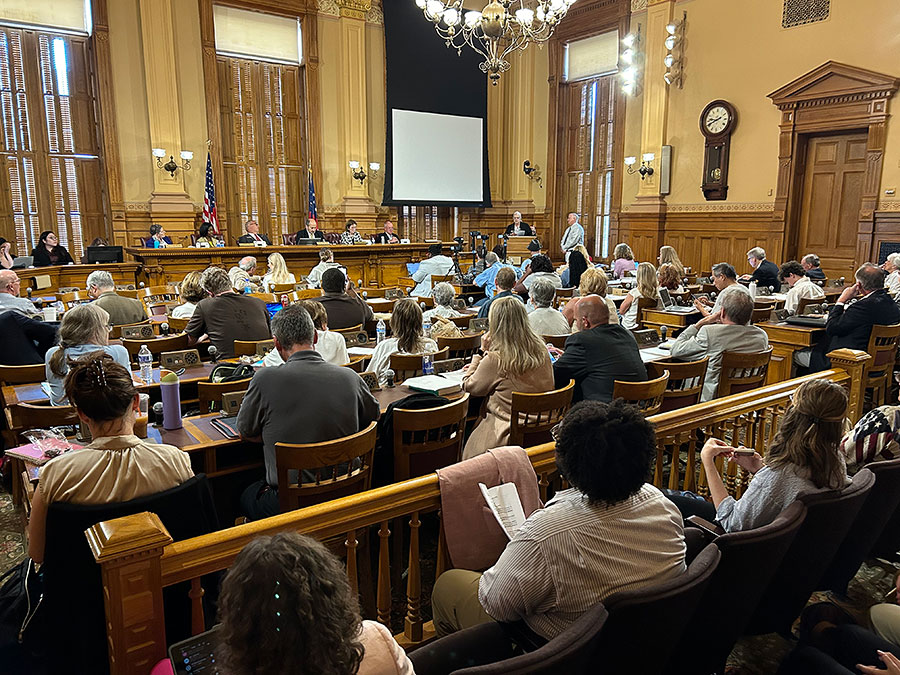
Cobb RA member Salleigh Grubbs (the Chairwoman of the Cobb GOP) won a solid victory on a rule proposal she presented before the Board in the afternoon. Salleigh’s proposal would have clarified that before local county Boards of Elections certify an election, they must first examine irregularities or inconsistencies to make sure the election was conducted accurately. So, for example, if the number of ballots cast is different from the total number of votes, this would be investigated and corrected before finalizing the report of the election results in a precinct or county.
Salleigh Grubbs presents her proposal in the afternoon session.
Chairman Fervier objected to Salleigh’s proposal, saying that it conflicted with a proposed rule change he had on the agenda. Salleigh replied to him with a polite smile, “I like my rule better than yours.”
Dr. Johnston expressed concern that the “guidelines” in Fervier’s proposal would create more restrictions on accountability. “It’s already too complicated,” added Janelle King.
After much discussion, when the Board voted on Salleigh’s proposal, Rick Jeffares (nominated by Lt. Governor Burt Jones) was the third vote in favor of Salleigh’s proposal. King and Johnston also voted in the affirmative.
The packed room exploded in applause with that win.
Happy Independence Day from the Georgia Republican Assembly!
It’s time to break out the fireworks and enjoy some tasty barbecue! Yes, it is good for our country to come together and celebrate days of remembrance.
But through all the fun, I hope that we make sure our children and grandchildren really know and understand why we are having all of these festivities. Because the battle-cry against tyranny that our founding fathers sounded in their generation is still the cry that we must sound today.
Our founders faced tyranny from the British King and Parliament. Today we face tyranny from global agencies, the White House, Congress, numerous federal agencies, sometimes the Gold Dome, and even our local county commission and board of election buildings!
Our founders gave their “lives, their fortunes, and their sacred honor,” and we are standing on their shoulders. We may not yet be called upon to risk our lives or our fortunes, but surely we can give something to the cause of freedom. It may be an evening at a county commission or board of elections meeting, or a Saturday door-knocking for a strong candidate.
Even more significantly, it may mean taking the time to personally raise our children (and not just let the government schools or the T.V. do it for us!). It may mean regularly going to church, and giving charitably to replace government welfare. It may mean working a job faithfully and living within our means so that we and our families don’t become dependent slaves of the state.
Some of these things may not sound all that political, but they are all a part of building a culture that makes America great again! That culture is what the French author Alex de Tocqueville observed about Americans in 1835 when he wrote: “America is great because she is good.”
An America that has that kind of culture can withstand any attempted tyrannies from the state. A hero in office like Donald Trump needs a people with that kind of culture to back him up and spur him on to success.
So let’s work to rebuild the best aspects of the American culture that first made it “great.” Let’s return to those founding presuppositions of the founding generation — not all of which they personally lived up to, but which they fearlessly proclaimed as the nation’s aspiration!
Let’s get back to acknowledging, first, as our founders did in the Declaration of Independence, that we are “created” by God with a special human purpose. We did not randomly happen to rise out of the ooze without meaning. We are not the product of chance. Moreover, there is a Divine Authority over all human authorities that holds them in check.
That Creator “endowed us with certain unalienable rights.” These rights mean that God has placed jurisdictional limitations upon civil government. He did not give them a blank check. The state may not morally murder (or help murderers get away with it), and it may not steal — just to touch on a few of the tyrannies our modern civil government regularly practices today.
We must expect better from our elected officials.
We must be willing to work as hard as our founders.
We must, as our founders, trust in Divine Providence.
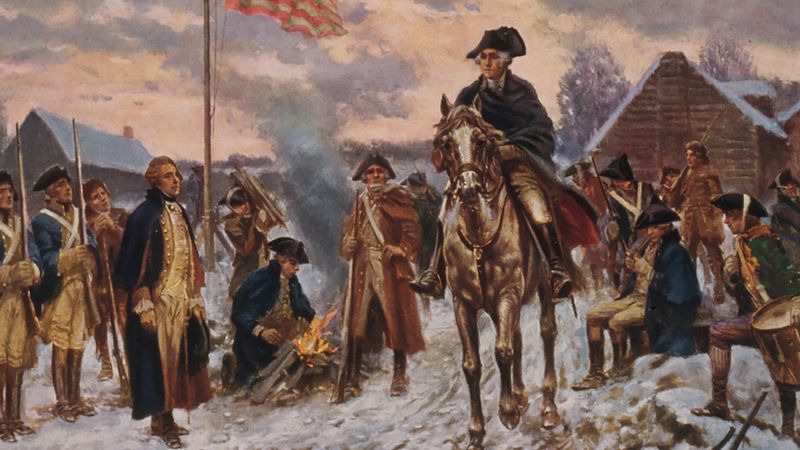
In 1775 when General George Washington was struggling to keep his army together in the war against Britain, the greatest empire on earth, he wrote:
“If I shall be able to rise superior to these and many other difficulties which might be enumerated, I shall most religiously believe that the finger of Providence is in it …”.
George Washington
We need to get down our knees and pray to God for help in our own battle against tyranny today. We need to acknowledge our sins, both personal and national, and turn from them. We need to ask God to forgive us and help us to overcome even as He helped the founding generation overcome in 1776.
We in the GRA are ready to lock arms with you in this endeavor. Reach out to us if we can help you in this on-going fight against tyranny!
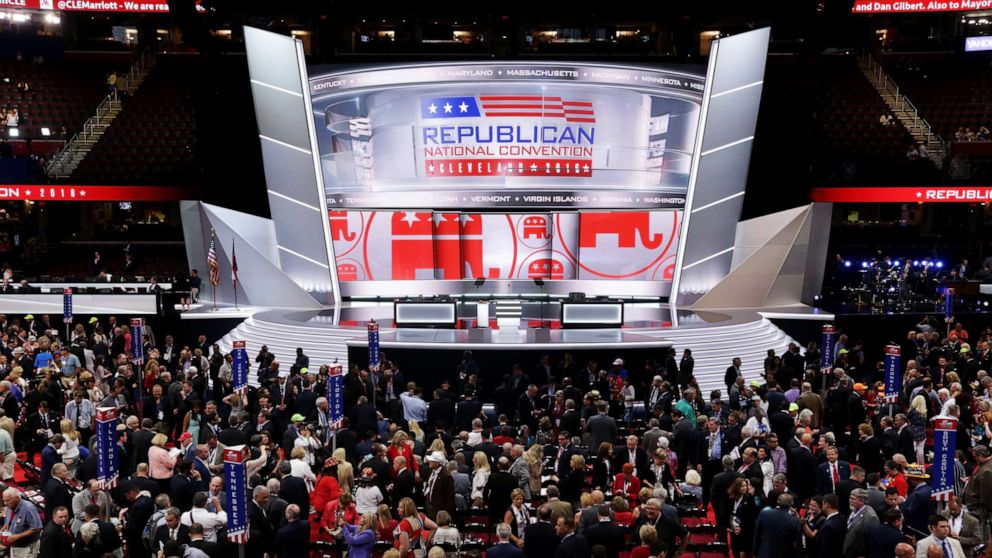
Spence Rogers reported on Twitter / X that “The RNC is making the RNC committee meetings secret so that they can update the RNC Platform with gay marriage, more immigration, and abortion.” RNC committee meetings are usually broadcast on C-SPAN.
Brant Frost V
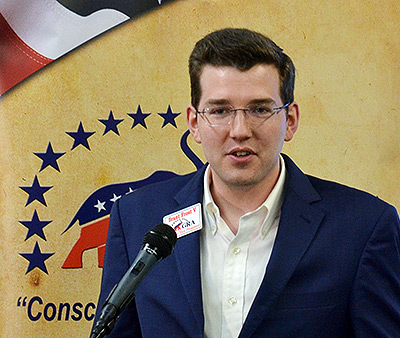
In response, GRA 1st Vice President Brant Frost V stated: “If true, as a member of the Convention Rules Committee, I will fight against any attempt to make convention committee meetings secret. Our grassroots have a right to know what we are doing. RNC Rules should REQUIRE open convention committee meetings.”
GRA Chairman Alex Johnson, who is also serving as a national delegate, agreed, saying: “The people who elected people to committees deserve to know what’s going on in the committees and how they are acting / voting (for accountability and future trust) …”.
GA GOP Chairman Josh McKoon and Suzi Voyles (both GRA members) are serving on the Platform Committee at the RNC. Urge them to oppose these kinds of back-door changes to the Republican Party Platform.
This article was written as a collaboration of GRA members involved with our newsletter team without contribution from any attorneys involved in the litigation.
The four candidates for county commission who the Catoosa GOP refused to qualify had done such things as repeatedly vote to raise taxes, take away the rights of citizens to raise chickens, and engaged in bullying of citizens protesting at commission meetings. One of them, Vanita Hullander, even publicly endorsed a local Democrat for office. Hullander was defeated last week in the Republican Primary runoff.
Click to see the video about the candidate qualifying case in Catoosa.
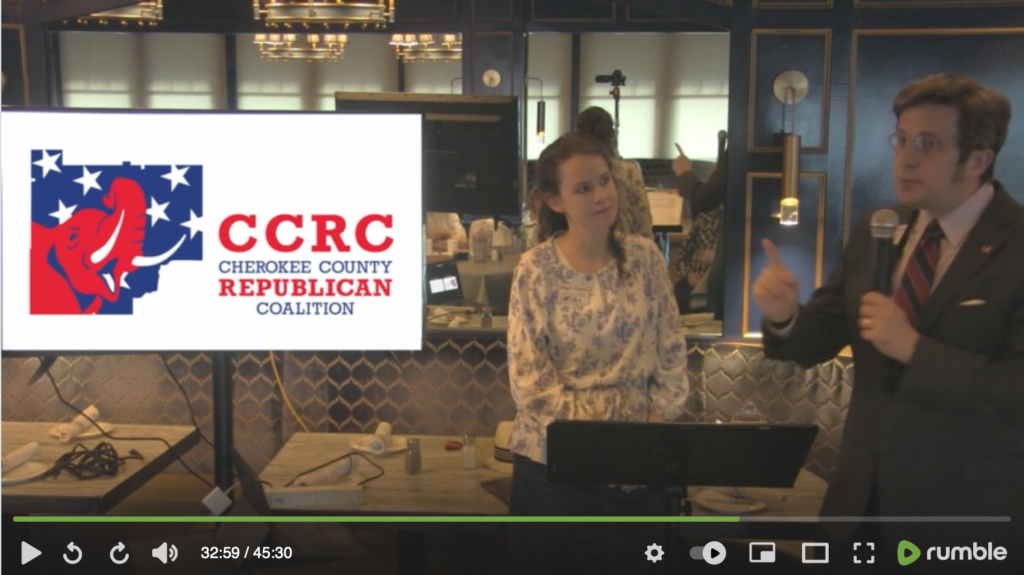
When “Republican Coalition, Inc.” organizations started popping up in different communities last year, starting in Cherokee County, many grassroots activists expressed alarm about why they felt the need to start such organizations. The organizations appeared to emerge first in communities where the grassroots had taken over leadership of local GOP organizations, wresting control away from the Establishment, oriented to the power at the Gold Dome. They appeared to be part of an effort to replace these grassroots-run organizations and delegitimize them. Some new activists have joined the “Coalition” mistakenly assuming they were the official GOP organization.
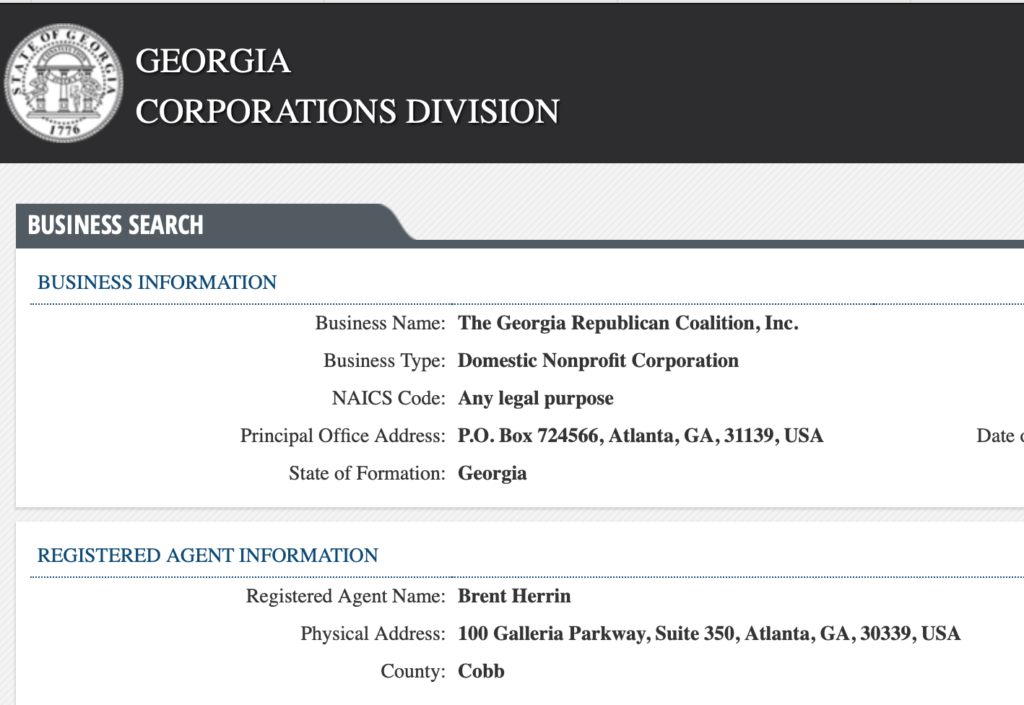
In particular, concern was expressed about how the “Coalition” accepted new members and whether those members had any vote controlling the activities of the organization. Unlike the official GOP organizations and the GRA, it appears the Coalitions are run top-down by the owners of the corporations. According to one Coalition member, Brent Herrin (who is the registered agent of the incorporated “Coalitions”) did not present the idea of filing an amicus in this case to them for discussion or a vote before it was filed — unilaterally. The Coalitions, thus, appear to operate without accountability.
Click to see the video presentation “A Tale of Two GOPs.”
This latest action by Herrin and company joining the lawsuit contradicts his repeated statements of reassurance that he and the Coalition have not been seeking to undermine the grassroots within the Republican Party of Georgia.
In addition to leading the “Republican Coalition, Inc.” and its various local chapters (nicknamed the “Whiners and Losers Club” by the North Metro RA chapter), Brent Herrin was also elected last year to the GA GOP State Committee on behalf of the 11th District GA GOP, which encompasses part of Cobb County, most of Cherokee County, and all of Bartow, Pickens, and Gordon counties. As a result of this betrayal and violation of his promises, we are calling on the grassroots in the 11th Congressional District GA GOP organization to vote to remove Mr. Herrin from any position of leadership within the GA GOP. He clearly cannot be trusted.
Herrin and company want to ensure that the Republican Party stands for nothing and is a meaningless label that anyone can purchase, regardless of their belief system.
The word “amicus” is the Latin word for “friend” and is the same root from which Spanish gets the word “amigo.” An amicus brief, thus, is an argument written by someone who is not a party to the case, but who wants to provide their input to the court and share outside information. The RINOs in Catoosa County and the Cherokee-based Republican Coalition, Inc. are certainly amigos, no doubt about it.
In the brief, Herrin argues that a candidate’s payment of the fee, and satisfying the procedural rules of the party are the only legal requirements for a candidate to appear on the ballot of their choice, and that Catoosa GOP’s process wasn’t actually procedural.
But what does the word “qualify” even mean if no one can be denied? Why call it a “qualifying” process if the only requirement for getting a place on the Republican ballot is that you have paid the money? Why not call it a “payment process” instead?
The word “qualify” implies that some who apply may not be approved, and others will. If it was an automatic matter of administration, a more apt term would be utilized. The Catoosa Republican Party is merely trying to enforce a minimum standard of adherence to basic GOP policy positions, and Herrin apparently thinks that is wrong. If Herrin is a true Republican, who shares a Republican belief system, why would he oppose efforts to ensure only true Republicans are labeled Republicans? If he truly believes the Democrat program is harmful, why wouldn’t he be concerned about undercover Democrats running as Republicans in rural GA?
If candidates do not have to meet minimum standards, then the word “Republican” has become a completely meaningless term. Herrin may argue that “the Republican voters” should be able to decide who can qualify in the Primary elections, but Georgia has an open primary system which allows even Democrat voters to cast a vote in the Republican Primary, determining our nominees. On the other hand, “the Republican voters” do get to elect the leaders of their local GOP organizations, as they have done in places like Catoosa and Cherokee counties.
Crawford “Republican” Commissioners Appoint Democrat to Elections Board
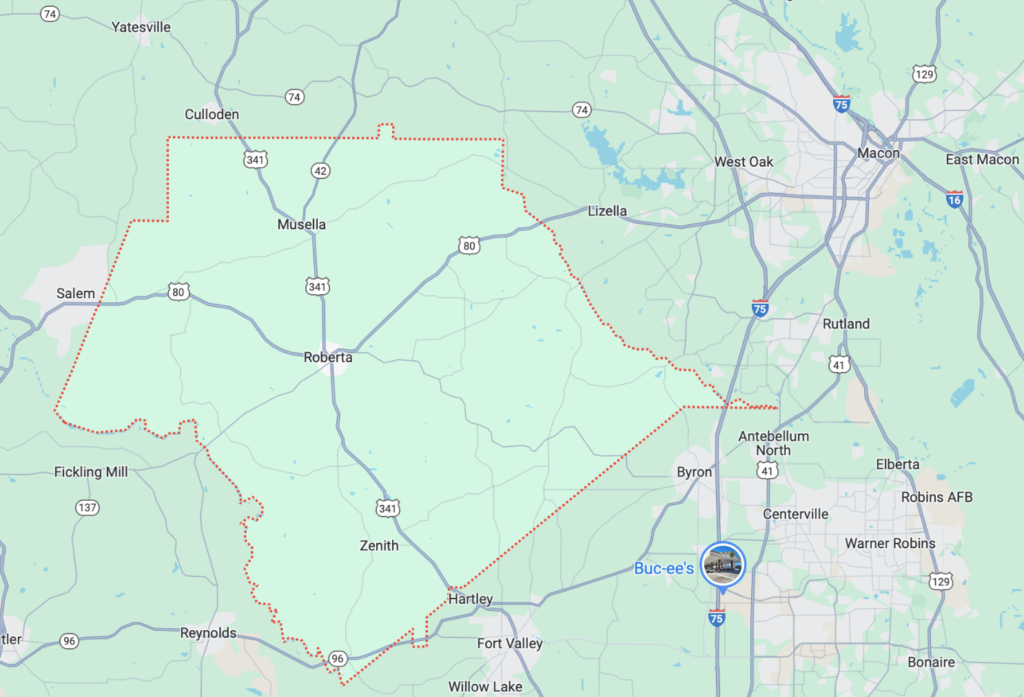
Crawford County, Georgia, west of Macon
Crawford County GOP Chairwoman Janet Carter reported that three of the Republican Commissioners in her county just voted to put a Democrat (who was actively trying to start a Democrat Party organization in Crawford) on the county’s Board of Elections. They did so by replacing a Republican incumbent who was seeking re-appointment. Now the Crawford County Board of Elections consists of two Democrats and one Republican in a ruby-red Republican county! This is yet another example in Georgia of where the local county GOP would have good reason to deny these county commissioners from running for re-election in the Republican Primary — because they did not prioritize the interests of their own party ahead of the interests of the opposing party.
The fact that state law allows political parties to conduct qualifying, and that the signature of the elected GOP officers is required to make the qualification official, indicates that GOP leaders are allowed to exercise some judgment about who does and who does not qualify.
Even so, the four denied Catoosa Commission candidates took legal action attempting to force themselves on the Republican ballot, contrary to the Catoosa GOP’s procedural rules. That has led to two cases that are pending on appeal in both state and federal court. We expect that the court will eventually overturn a local judge’s actions to force the candidates on the ballot, contrary to the 1st Amendment.
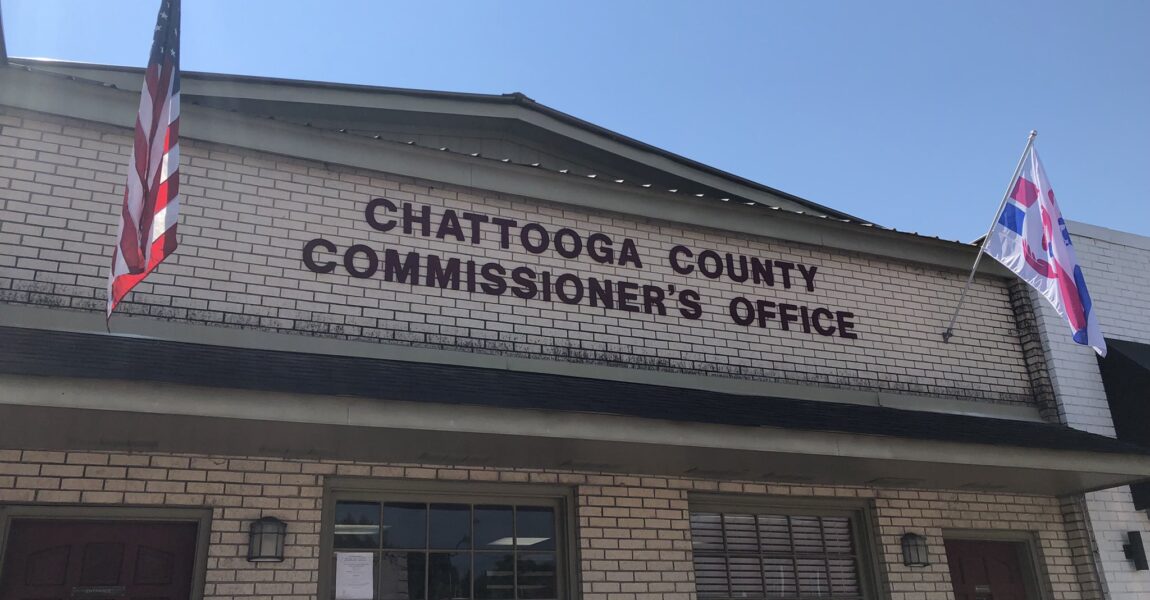
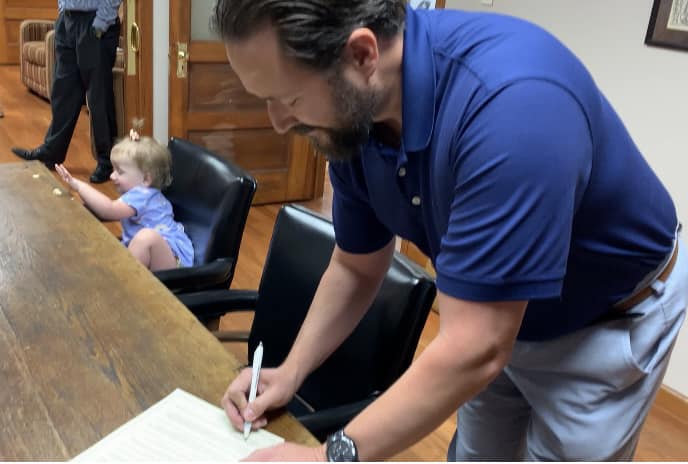
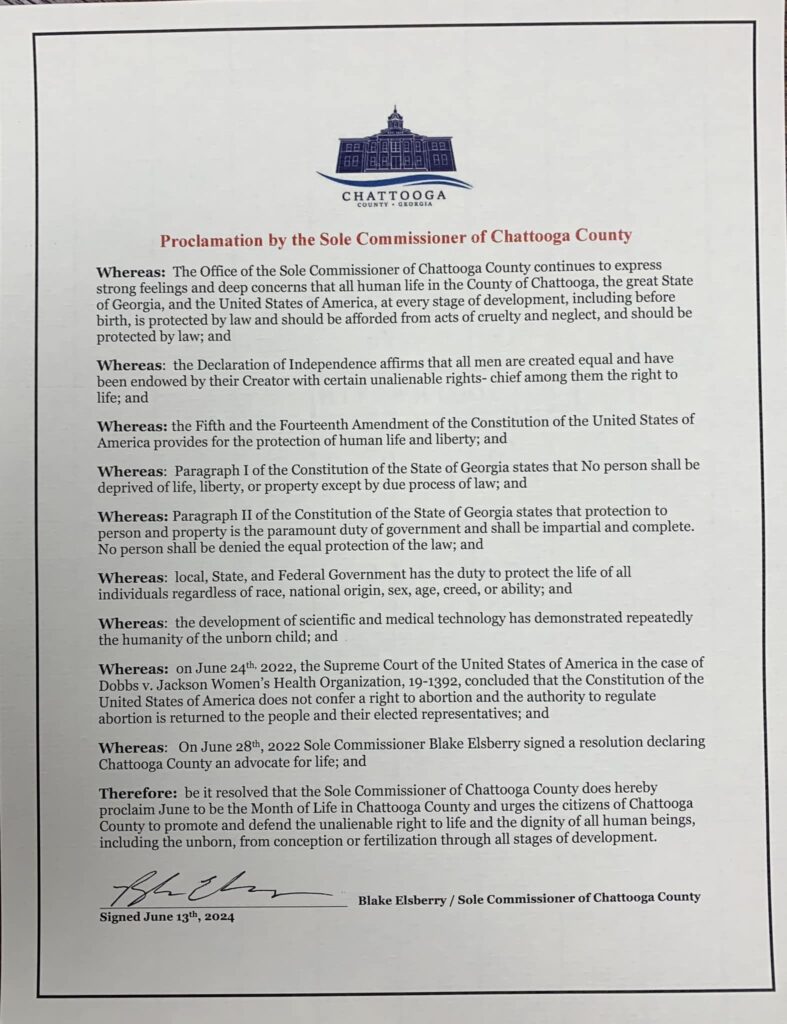
Summerville, GA — On June 13th, GRA-endorsed Chattooga County Sole Commissioner Blake Elsberry signed a local proclamation declaring the month of June as “the month of Life!” While liberals bolstered by the Biden White House and ESG corporate pressures have been pushing June as unnatural sex “Pride Month,” for many conservatives, June has become the month they celebrate the anniversary of the U.S. Supreme Court Dobbsv. Jackson decision that overturned the notorious Roe v. Wade precedenton June 24, 2022.
Roe unconstitutionally forced states to legalize abortion murder across the country. This was not a decision made by a vote of American citizens or even their elected legislative representatives at any level of civil government, but by unprecedented judicial fiat of seven of the nine Justices on the bench in 1973. Tens of millions of preborn infants have been murdered as a result of that ruling, and the Dobbs decisions has restored to the states the opportunity to provide equal protection of preborn human beings.
Commissioner Elsberry signs the proclamation.
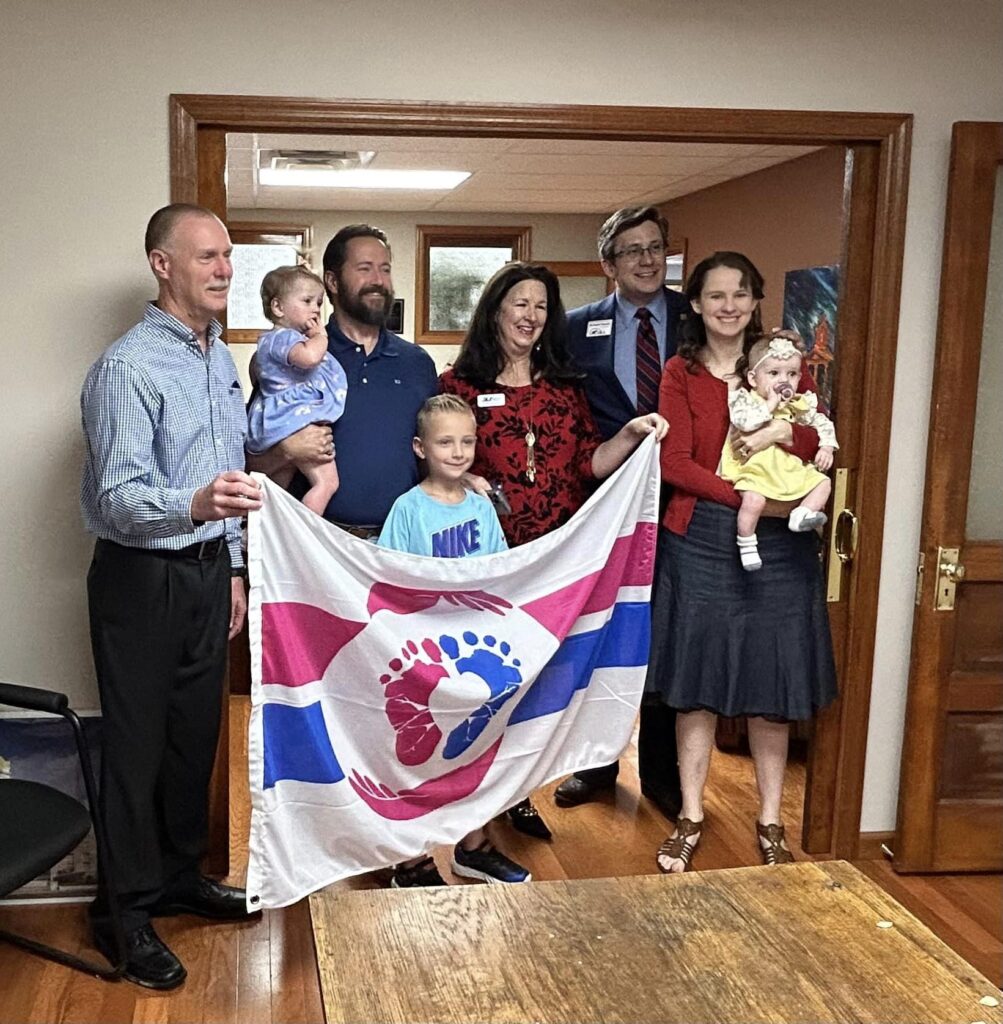
GRA President Nathaniel Darnell and GRTL 1st Vice President Abigail Darnell (also the junior GRA NFRA Director) were pleased to be present for the signing of the Chattooga proclamation, and we commend Commissioner Elsberry for his leadership. We would encourage other county commissioners to take similar action across the state. The Chattooga County Commissioner also proudly flew a pro-life flag presented to him at the signing.
In the Bible, God expresses such grief against “hands that shed innocent blood” (Proverbs 6:17) that the Lord repeatedly charges civil magistrates with the responsibility to civilly punish murderers after a trial with due process, even requiring the death penalty for those found guilty. (See, e.g., Genesis 9:6; Exodus 21:22-23; Leviticus 24:17; Romans 13:1-4.) A culture that winks at this evil contributes to cultivating a generation that looks callously at human life, producing more violence. Such a culture can expect to incur the same kind of providential judgment we see God bring upon nations throughout biblical history — an understanding founding fathers like Ben Franklin and Alexander Hamilton cited in their deliberations over adopting our U.S Constitution in 1789.
Examples of providential judgements we may already be experiencing for not taking this on-going murder seriously could include: stolen elections, continued high inflation, endless wars, a growing deficit, encroaching civil government tyranny, and general civil unrest. We must repent and turn our ship of state.
The proclamation signed by Chattooga County Commissioner Blake Elsberry.
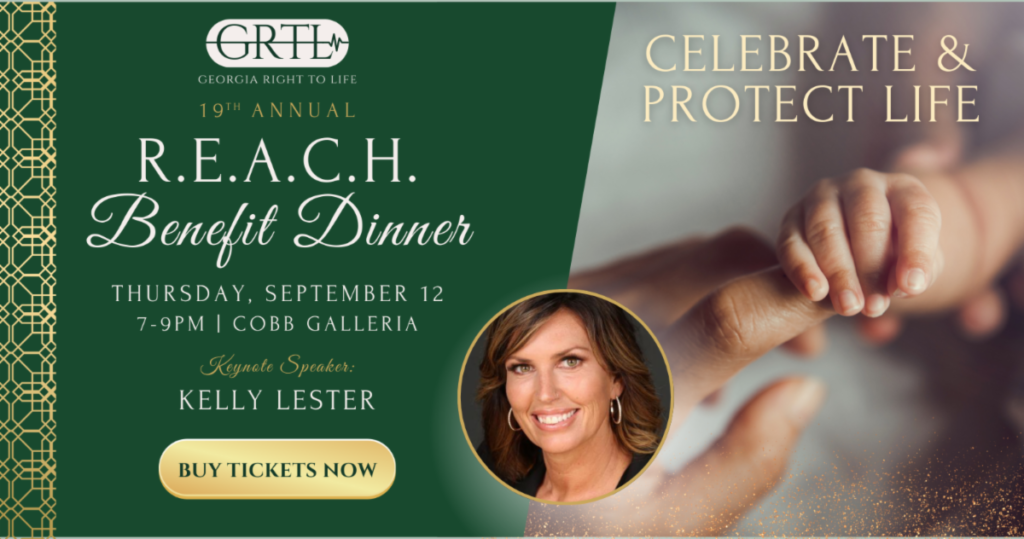
One way you can advance pro-life accountability from Republicans in Georgia is to attend the Georgia Right to Life’s REACH Benefit Dinner! Please mark your calendar and plan to join us at the event on September 12th as we continue to work to advance equal protection for all human life — born and pre-born!
The REACH Benefit Dinner on September 12, 2024 includes a delicious meal and an inspiring program that will be held at the elegant Cobb Galleria from 7:00 PM to 9:00 PM.
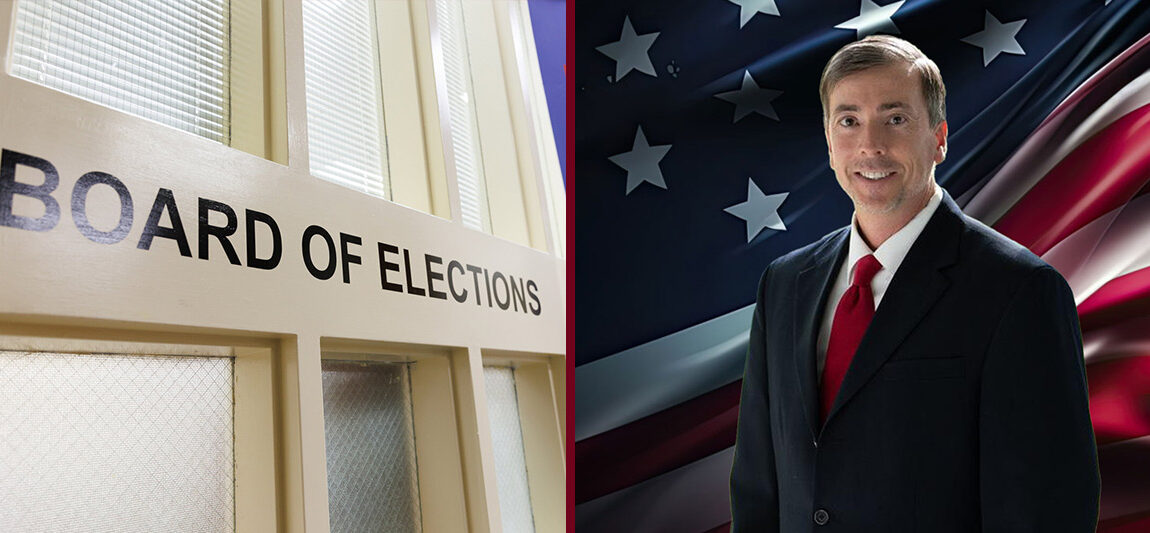
Atlanta, GA — Today GRA President Nathaniel Darnell appointed Fulton County activist and GRA member Jason Frazier as the Chairman of the newly-created GRA Election Integrity Action Group.
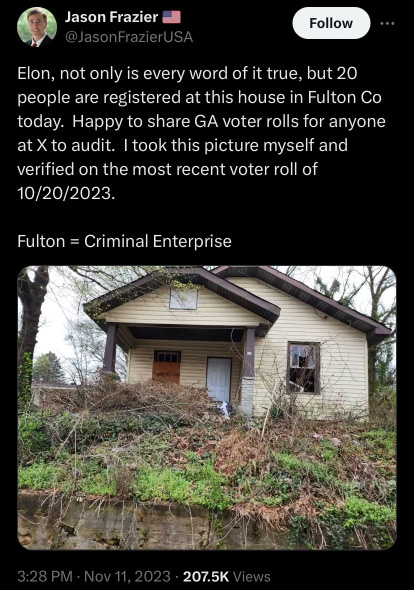
Frazier has exposed issues like this abandoned house in Fulton County that had 20 voters registered as living there.
Since the 2020 election, Frazier has successfully challenged and removed thousands of illegitimate registrations in Fulton County. He has testified before the State Senate, influencing election integrity legislation. Last year, he was nominated to the Fulton County Board of Registration and Elections, although the Democrat-controlled Board refused to seat him. He’s developed analytical models to identify invalid registrations and collaborated with software developers to improve registration verification.
Now Frazier is looking to take the method state-wide that he has used to successfully uncover local problems in the Fulton voter rolls. GRA members from across the state will be coordinating with him to challenge voter registrations in Georgia by people who are also registered in other states, among other things.
After joining the GRA, Frazier reached out to GRA Chairman Alex Johnson a few weeks ago about his proposed idea to build a state-wide team from the GRA for this purpose. In a recent poll of our membership, many members responded with an eagerness to join the effort.
Send us a message if you would like to be a part of this significant initiative.
In the last 24 hours, we have witnessed two more instances of unprecedented lawfare targeting right-wing figures. Steve Bannon faces imprisonment, while Dr. Eithan Haim, who blew the whistle on Texas Children’s Hospital’s illegal child sex-change program, is now being prosecuted by Joe Biden’s DOJ on what many see as outrageous and trumped-up charges.
America is increasingly polarized and divided, with Democrats driving this divide through unjust legal actions across our nation. This situation is further exacerbated by the cases in Georgia and Arizona against alternative slates of electors, which hold significant weight in both legal and political history.
Dr. Eithan Haim
The prosecution of Donald Trump across multiple states is a glaring example of the corruption and political bias infiltrating our justice system. In New York, the former president faces charges stemming from what many consider a politically motivated investigation into his business dealings. In Georgia, Trump and his associates are entangled in a case driven by partisan interests, targeting alternative electors in an unprecedented move that undermines the democratic process. Meanwhile, in Florida, Trump is contending with allegations related to classified documents, further showcasing the relentless legal assault aimed at derailing his political career. These cases collectively illustrate a concerted effort to weaponize the legal system against a prominent conservative figure, underscoring the urgent need for Republicans to unite and fight back against these corrupt practices.
As the Georgia Republican Assembly, we call on Republicans from across the nation to unite around our presumptive presidential nominee, Donald Trump. It is crucial to take the fight to the Democrats by organizing, mobilizing, and electing true Conservative politicians who will combat these corrupt abuses at the local, state, and federal levels.
Together, we can stand against the misuse of the legal system and uphold the principles of justice in America.
Columbus, GA — Some significant wins in Columbus got overlooked with all of the other activity. On Thursday, the GA GOP State Committee passed a resolution introduced by Sam Carnline with Georgians for Truth which called on the State Elections Board to follow the recommendations of Republican-appointed member Dr. Janice Johnston. David Withamattempted to water down some of the strong wording of this resolution, proposing that a “reprimand” of egregious state actors be removed. GRA Chairman Alex Johnson argued against that amendment, and GRA members on the State Committee helped to see that resolution successfully passed as originally worded.
State Committee Meeting
In an earlier State Committee meeting on February 29th, the GA GOP State Committee had passed a resolution against lobbyists serving on the State Elections Board. The committee affirmed that resolution last Thursday. The GA GOP has also added a ballot question for the Republican Primary ballot asking voters, “Should the legislature ban registered lobbyists from serving on the State Elections Board?”
The Cobb delegation was the largest present at the convention with 128 delegates.
In fact, resolutions do matter, which is why Establishment RINOs at the state convention fought so hard to thwart resolutions again this year. You may recall that resolutions did not get passed last year at the convention because the convention lost quorum. On Saturday, as soon as the agenda of the convention was presented, GRA President Nathaniel Darnell from Cobb made a motion to move the Resolutions Committee report up as the first item on the agenda. This motion was narrowly defeated, but then GRA member Amanda Prettyman from Bibb County made a motion to reduce quorum to those present at the convention. This motion was adopted.
The effect of Prettyman’s motion was to ensure that if too many delegates left after the elections, but before resolutions had been addressed, the convention would not be forced to adjourn again due to a lack of quorum.
At this point in the convention, Establishment RINO delegates attempted to force the body to adjourn. Multiple motions for “point of order” were shouted to prevent this attempt to block all resolutions while the adoption of the Resolutions Committee report was pending. Chairman Josh McKoon ruled that the motion to adjourn was out of order, and the body voted to adopt the Resolutions Committee report, which included an excellent GA GOP Platform and other resolutions.
But before the body could return to the question of discharging any resolutions not included in the Resolutions Committee’s report, the Atlanta-controlled Establishment once again made a motion to adjourn, which this time was successful. The question of whether to qualify Brad Raffensperger as a future candidate will be re-visited later, but at least this time the main body of resolutionsdid get voted on and approved by the state convention.
A whopping 53 Catoosa County voters filed official voter challenges to the qualifying of these four candidates and this hearing was called to consider the controversy and give those 53 voters an opportunity to speak before the board.
GRA President Nathaniel Darnell reports live at the Catoosa County Board of Elections Hearing
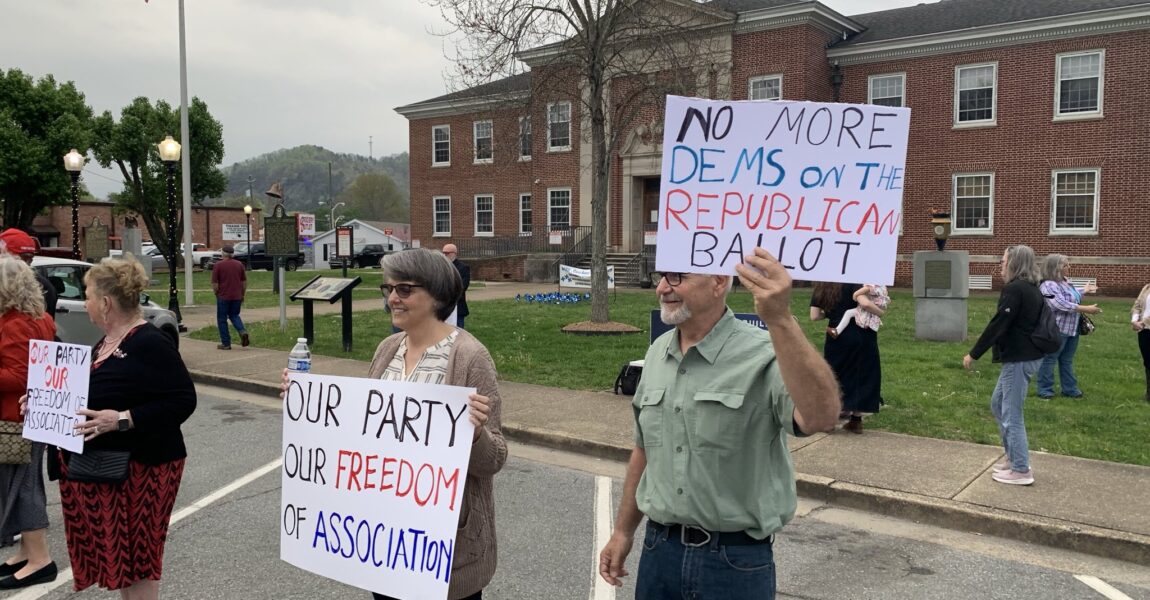
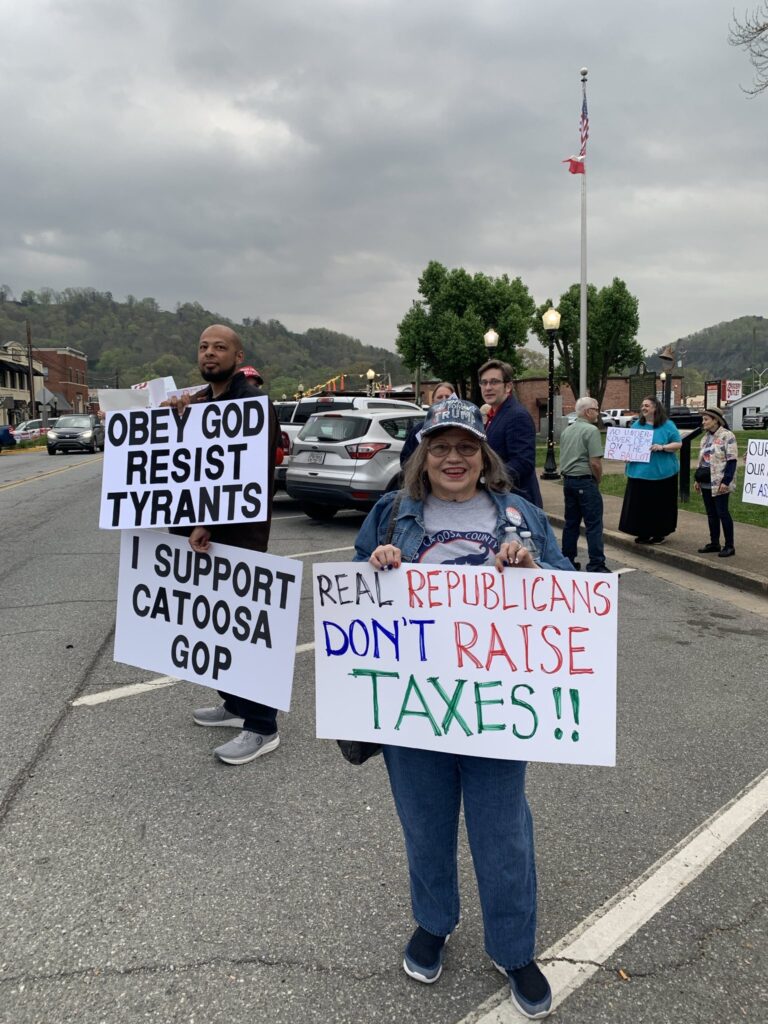
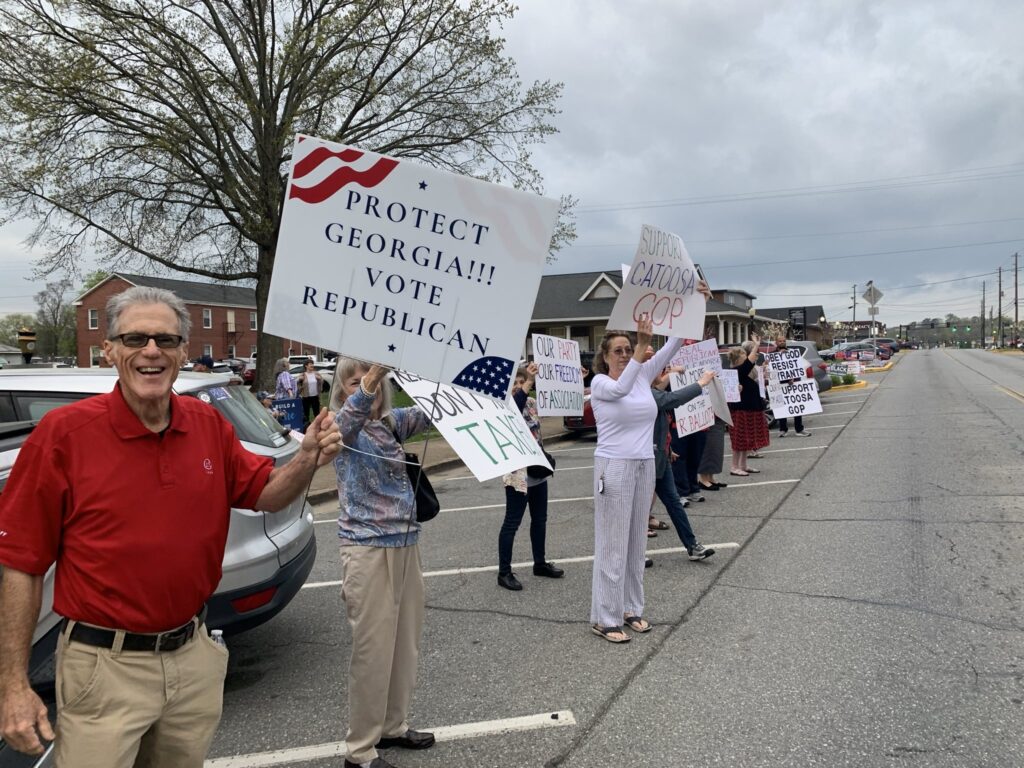
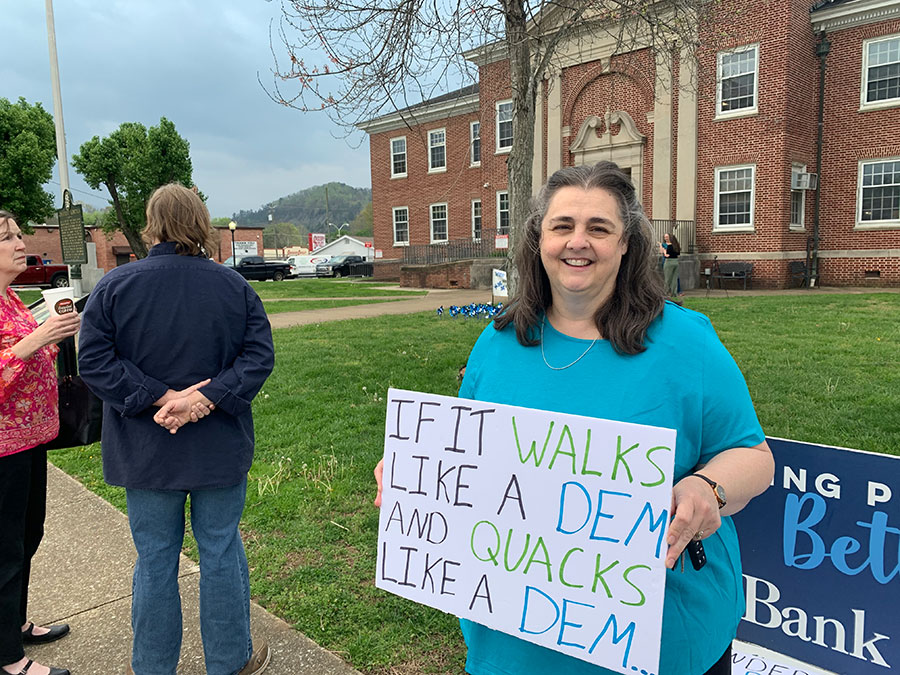
More than 25 patriots gathered outside the courthouse before the meeting, waving signs in favor of the GOP and the accountability rule that ultimately led to the denial of the Republican brand to four commission candidates: Steven Henry, Larry Black, Jeff Long, and Vanita Hullender.
“The only reason that we are here today is because the law has not been followed,” said Catoosa GOP member Adrianne Kittle at the hearing. “I am angry that I have to be here today all because there are four individuals who want to steal the Republican brand and strong arm their way onto the Republican primary ballot. … Each candidate voluntarily participated in the process and interview … and they did not pass because their actions while in office are the antithesis of a Republican Representative!”
More than a dozen citizens spoke to the board in protest of Judge Don W. Thompson’s order to circumvent the party and have the elections superintendent qualify the candidates as Republicans in spite of the party.
Those making public comments were compelled to be “sworn in” like in a trial. “I was on the elections board for 18 months,” said Debbie Gwaltney. “During my time as a board member, not once did we ever put someone under oath to testify before the board in a public hearing. I’m flabbergasted!”
Furthermore, attorneys for the RINO candidates were allowed to bring in “witnesses” who had not filed formal complaints or voter challenges with the Board.
The attorneys for the RINO candidates even attempted to cross-examine each of the voters after their public comments! They squabbled over definitions and posed numerous leading questions to put words in the citizens’ mouths. After seeing numerous “cross examinations” of their fellow patriots, speakers began refusing to answer questions.
Another unjust aspect of the hearing was that the four attorneys for the candidates were allowed to each give “closing arguments” like in a court hearing. All four attorneys gave their own closing arguments, but not one person was allowed an equal opportunity to give closing arguments for the Catoosa GOP before the Board moved to executive session and the vote. It was as if they treated it as a judicial hearing when it benefitted the RINOs and then treated it like a normal, casual board meeting when it came to the Catoosa GOP members. All of these things just infuriated the patriots more and more.
NWGRA Member Jim Coles from Catoosa made several helpful analogies to drive home the importance of freedom of association. “Would you force the Republican Jewish Coalition to accept a Neo-Nazi member? Would you force the NAACP to accept a KKK member?” asked Coles.
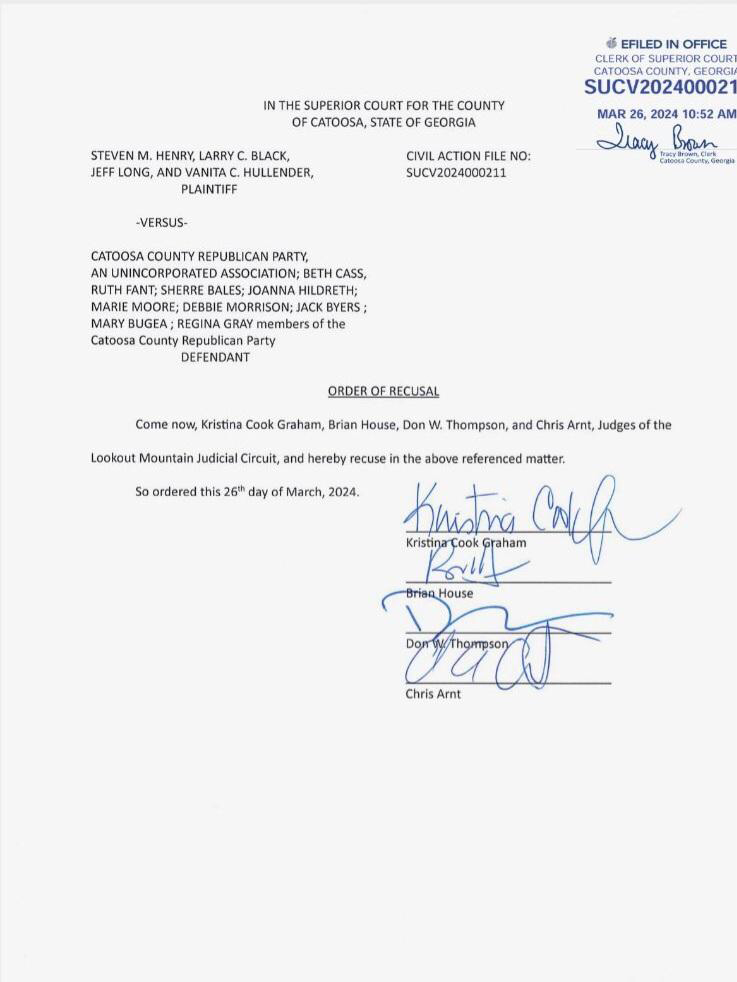
Ringgold, GA — Tuesday the four local judges in the Lookout Mountain Judicial Circuit filed to recuse themselves from the case in Catoosa in which four candidates are trying to use the civil government to force themselves on the Republican Primary ballot. We are pleased to report that the appeal is moving forward, and the Catoosa GOP is committed to continue fighting for the constitutional right to freedom of association. The government does not have the constitutional authority to force a private entity such as a political party to publicly associate with someone who does not represent their values.
We applaud that Judge Thompson and the other three judges on the Lookout Mountain Judicial Circuit who have recused themselves to ensure this case can be given fair and unbiased consideration.
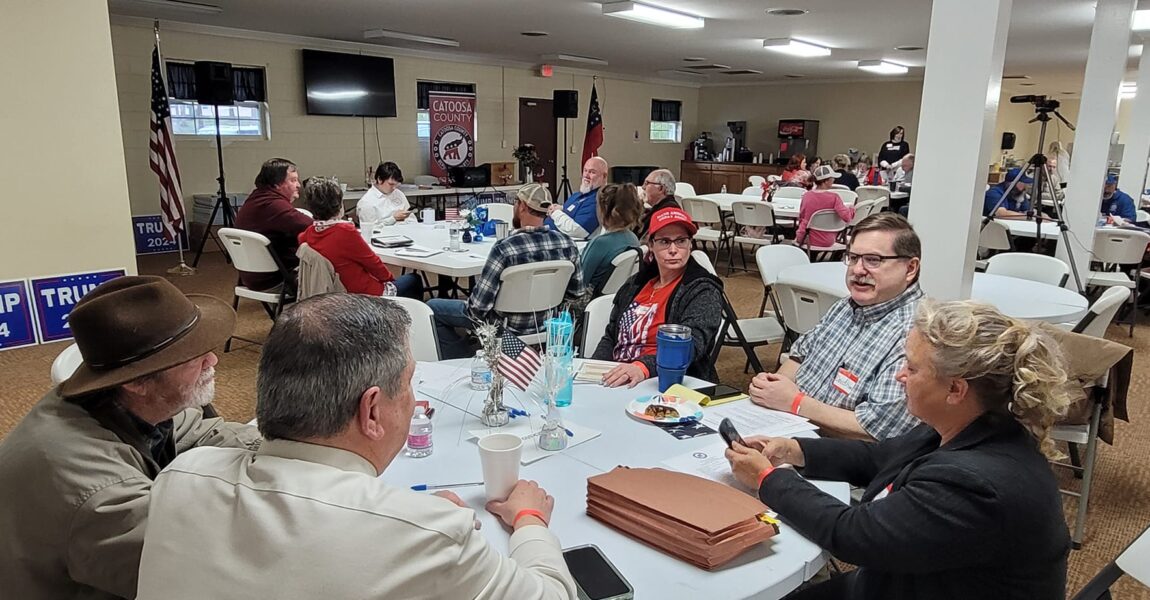
Last Saturday the Catoosa County GOP hosted one of the largest attended county conventions in recent history and if any Republican voters had concerns about the Catoosa GOP leadership, they did not show up at the convention to express it. The unity and enthusiasm in the room was unmistakable. None of the people trying to force their way on to the Republican Party ballot or their alleged supporters were in attendance. We are glad to see the unified support from Republicans in the Catoosa community to only have Republicans on the Republican primary ballot.
The Catoosa GOP Convention unanimously passed the a resolution in full support of the Catoosa GOP leaders in their fight for freedom of association.
Next Tuesday, the Catoosa Board of Elections will be holding a hearing at the Catoosa County Courthouse to hear from local citizens who have filed challenges to the four candidates being forced onto the Republican primary ballot. That hearing is expected to start at 9:00am.