Author: Abigail Darnell
Surviving Socialism — Beatings, Starvation, & Political Prisoners: True Stories from Survivors

Surviving Socialism — Beatings, Starvation, & Political Prisoners: True Stories from Survivors

Kennesaw, GA – On Wednesday, three victims from Communist countries shared their stories of abuse and hardship suffered while living under totalitarian regimes. The event was hosted by Citizens for Free Enterprise and featured a panel including immigrants from Communist Cuba, Communist Romania, and Communist Venezuela.

“I was arrested as a 15-year-old kid in Cuba,” said Colonel Arch Kelly. “The only thing that saved me was the fact that I was an American citizen.” Kelly was from an anti-communist family. His father fled Cuba abruptly after receiving a tip that his life was in danger.

“My mother was not so lucky… Two members of the Ministry of the Interior came over to the house and beat the crap out of my mother and beat the crap out of my eleven-year-old sister that was trying to save my mother from harm.”

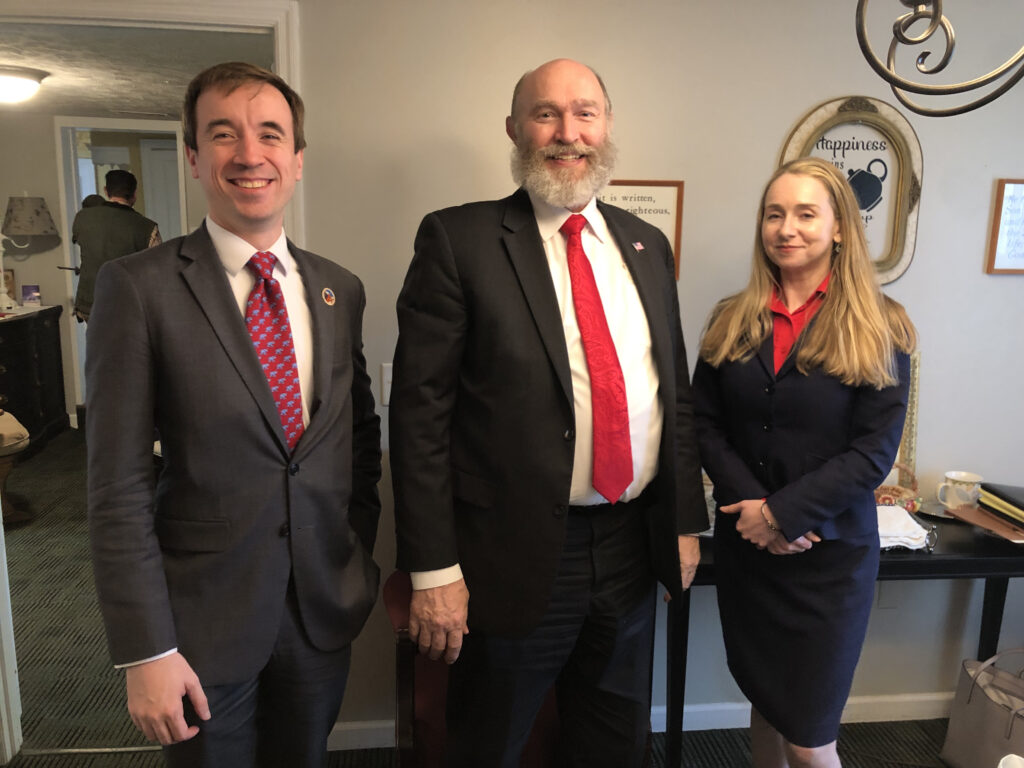
Abigail with Frida, one of the attendees at the “Surviving Socialism” event

“We were able to get out, but many of my friends were not able to get out and they were murdered – they were killed by the communists in Havana. Many others that were not immediately killed were actually sent to prison and some of them are still in prison after all these years. There’s over 20,000 political prisoners. These are people that are anti-communists and they are rotting away in the communist jails that still exist in Cuba.”

The panelists all described remarkably similar experiences despite living in different countries under different dictators.

“There is no bigger criminal cartel than Communism,” said Dr. Alise Cua, a survivor who spent her childhood in Communist Romania.

“They confiscated land by eminent domain,” she said. “When people tried to resist, they were killed.”

“You couldn’t criticize the government,” Dr. Cua said.

The panelists shared that to criticize the government would risk getting arrested and never seeing your family again.

Their stories were heartbreaking. Col. Kelly, now an elderly man, had traveled the world and witnessed conditions in other countries where Socialism had been adopted. He described Communist Hungary:

“It was like watching a bad Hollywood movie – trucks full of soldiers every place that you went.”

While some today attempt to make a distinction between Communism and Socialism, the three panelists didn’t see it that way.

“Socialism is just one step away from Communism,” said Col. Kelly.

“‘Free food, free college’ they say… but with shekels come shackles,” said Dr. Cua.

“Socialism and Communism are very much on the same spectrum. It’s kind of like splitting hairs. It’s a slippery slope,” said Dr. Cua. “Don’t try to differentiate between Socialism and Communism because it’s really like an academic differentiation. It doesn’t matter. It’s all the same thing. It’s control, oppression, poverty, lack, intimidation.”

It is worth noting that Communists seldom call themselves Communists. The Soviet Union called itself Socialist, not Communist. The “USSR” was the “Union of Soviet Socialist Republics” — not “Communist Republics.” Similarly the Nazi party in Germany was officially the “National Socialist German Workers’ Party.”

At a distance Socialism looks like glittering free stuff, but up close you find it’s all barbed wire.

Empty Shelves, Starving People

“There were only two TV stations [in Romania] and one was just propagandizing about how great the country was and meanwhile you go to the grocery store and the shelves were empty,” said Dr. Cua.

“We would stand in long lines for bananas…We would take public transportation because we heard that there was, like, you know, potatoes or something basic being sold across town and we would go stand in line,” she said.

Panelist Alejandra Warren was in college when she observed the sudden Communist regime take over her home country of Venezuela.

“When I was in college we couldn’t buy soap because they knew by my number that I had already bought soap or toothpaste last week,” said Warren.

“Gas was free, but you had to pay the guy to pump the gas… and you had to wait in line for days to get gas. You would have to get in line at 5:00 in the morning, or 3:00 and then you would pump at night. That’s how long it would take you.”

“Communism doesn’t work,” said Col. Kelly. “It doesn’t work here, it doesn’t work in Asia, it doesn’t work in Russia… we saw that with our own eyes.”

The Religion of Communism

Communism isn’t merely a bad economic policy that fails. It is more sinister. Colonel Kelly relayed an appalling story he heard about Cuban education facilities. …

Read more on Abigail’s Substack here.

What Can Be Done about Flock Cameras?

What Can Be Done about Flock Cameras?

Map of 10,000+ Flock cameras in Georgia.

Over the last few months, social media has exploded with conservatives becoming alarmed about the government’s use of Flock cameras. Flock cameras are a type of Automated License Plate Reader — a camera placed on public property that runs non-stop surveillance, collecting data on the location of vehicles at specific times. This data collected on innocent citizens, is purportedly used to aid law enforcement if and when needed. However, Flock cameras raise serious concerns about constitutional privacy rights since these license plate reader systems continuously record your movements without a warrant, without probable cause, or even reasonable suspicion

The 4th Amendment to the U.S. Constitution says:
“The right of the people to be secure in their persons, houses, papers, and effects, against unreasonable searches and seizures, shall not be violated, and no Warrants shall issue, but upon probable cause, supported by Oath or affirmation, and particularly describing the place to be searched, and the persons or things to be seized.”

The question is, does constant recording of American citizens in public places meet the definition of “unreasonable search”?

Alex Johnson

“Politicians are doing their best to put out a bunch of meaningless rhetoric about how they will do ‘something’ to ‘regulate’ surveillance cameras,” said GRA Chairman Alex Johnson, “without actually committing to doing anything.” 

According to Deflock.org, there are upwards of 10,000 Flock cameras currently being used in Georgia. For people who know history and understand the constant threat of totalitarianism that has plagued mankind since the first egotistical monarch, Pharaoh, or sultan ever said “off with his head,” Flock cameras are terrifying. Communist dictators of the last century were eager to collect data on law abiding citizens and would have jumped with glee if they had been enabled by Flock technology and AI.

This week Nathaniel Darnell, Field Coordinator for The John Birch Society, and the GRA President, was interviewed on the Tennessee Informer podcast about The John Birch Society’s position on the constitutional right to privacy and the growing concern with Flock cameras. “It’s like 1984!” said Darnell.

Click to watch the interview with Nathaniel Darnell on the Tennessee Informer.

He pointed to the numerous instances of abuse by law enforcement. For example, Reason.com reported 20 Georgia officials have been arrested for misuse of Flock cameras.

Many have accessed the data to stalk women. But that’s not all. What about when the technology gets it wrong? There has also been a fair number of false positives that have led to innocent people being wrongfully arrested at gun point, all because a Flock camera misread a license plate.

“In Aurora, Colorado in 2020, a mother and her family, including her 6-year-old daughter, were pulled over at gunpoint and forced to lie face down on hot pavement due to an ALPR error. Police mistakenly flagged their Colorado license plate as matching a completely different vehicle,” reported Deflock.org.

“The incident, captured on video and widely condemned, led to a $1.9 million settlement from the city in 2024.” See CBS News report.

Additional concerns arise when we consider whether local law enforcement offices are automatically sharing their surveillance data with national, three-letter agencies at the federal level. How many government employees have access to it? Wouldn’t more people having access to the data increase the risk for abuse and harassment.

Justifying the Unjustifiable

Some would argue that the concerns with Flock cameras are all justifiable if the use of Flock cameras helped to solve even one crime. It is a reiteration of the old “the end justifies the means” rationale.

But the 4th Amendment exists for a reason.

One of the benefits of 4th Amendment privacy rights is that it slows down justice to ensure innocent people are not harmed during the pursuit of criminals. Innocent law-abiding people should never have to endure the trauma of a guns drawn raid, or feel violated by the search of their home, car or personal effects without a warrant and sufficient reason to suspect them.

The Founding Fathers had a Christian worldview and held that all men — including government officials and law enforcement — are depraved and sinful. They possessed a keen distrust of human civil government and that distrust is why we have the Bill of Rights.

They did not hold to a “catch crime at all costs” view. Rather, they severely limited the power of the state in order to ensure innocent law-abiding individuals are not unnecessarily violated or taken advantage of by the pursuit of justice.

They were gravely concerned about misuse of authority and took precautions to protect against those abuses. If a cop were to follow you around and track all your daily habits, without a warrant, that would be highly inappropriate, and probably considered harassment. Law enforcement should not be allowed to commit crimes themselves under pretense of catching criminals.

The Good News

Flock cameras are not permanent and unalterable. Many cities and counties have cancelled their contracts with Flock, or deactivated their cameras. People are speaking out. In one of the more entertaining examples, a San Diego man dressed as Darth Vader spoke satirically in favor of Flock Cameras and how they benefit “the Empire”.

It is encouraging to see the massive public opposition to this government surveillance network. The fact that the decision to use or not use automated license plate readers rests in the hands of your local government (not Congress or D.C. bureaucrats) makes it far more likely that patriot activists can make a difference and reverse this trend.

How You Can Help

If you are concerned about Flock camera surveillance and potential harassment please talk to your local Sheriff and local government and share with us and your fellow advocates what you have learned.

Judge Declares GRA Innocent of Baseless Ethics Complaint

Judge Declares GRA Innocent of Baseless Ethics Complaint

Atlanta, GA — Today, Judge Dominic Capraro at the State Office of Administrative Hearings released a decision that all allegations that the Georgia Republican Assembly and GRA-PAC broke the law are unfounded. Both organizations are innocent of the ethics commission’s frivolous complaint.

The decision stated: “In accordance with the foregoing findings of fact and conclusions of law, the Court finds that the Respondents are not in violation of the Act as alleged in the Commission’s Statement of Matters Asserted and, therefore, no sanction is due.”

GRA Chairman Alex Johnson, who is also an attorney, stated: ”It is standard practice for the paid political industry and spineless politicians to try to silence effective volunteers that are trying to hold them accountable. We are glad Judge Capraro was able to see through this and reach the correct outcome in this matter.”

On May 13th, Georgia Republican Assembly NFRA Director & attorney Catherine Bernard represented the GRA in the hearing for the complaint against the now terminated GRA-PAC. The State Ethics Commission previously added the GRA Inc., the membership organization, to the complaint suggesting that the membership organization was one-in-the-same with the GRA-PAC which is not true.

Attorney Catherine Bernard cross-examines Timothy Baywal at the hearing.

Timothy Baywal, staff attorney for the Georgia Ethics Commission, was the primary witness and after Bernard’s brilliant cross-examination, he had to walk back his position from last December and thoroughly contradicted the legacy media’s narrative.

“It was never my position that they were trying to pump dark money into elections,” Baywal testified under oath.

“I don’t think anybody was trying to do anything illegal or unlawful,” said Baywal.

Baywal admitted on the witness stand that GRA-PAC’s expenditures were in fact disclosed to the State Ethics Commission.

“All of these were disclosed in GRA-PAC filings. I was never claiming they weren’t disclosed. They were disclosed improperly,” said Baywal.

The Judge’s decision reveals that expenditures of the GRA PAC were not disclosed improperly, as Baywal alleged, because the statutory definition of an independent committee is an entity which is explicitly “not a Political Action Committee” (O.C.G.A. § 21-5-3(15) (2025)). Judge Capraro found that, since both entities “do not meet the definition of an independent committee, they cannot be considered to be in violation of Georgia Code Section 21-5-34(f), and no sanction is authorized.”

Bernard discusses case with Baywal and Elizabeth Young during a recess.

This is a huge vindication for the GRA and will come as a massive disappointment to the Establishment operatives in the GOP who thought they smelled blood in the water. An AJC reporter attended only a portion of the hearing, and it is likely this vindication of the GRA will be entirely ignored by the far-left news media who care more about spreading propaganda and casting shade on conservative groups than reporting the truth or correcting their previous articles.

Attorney General Chris Carr, one of the politicians in the Atlanta swamp that GRA members frequently criticize for his inaction on important issues, formally called for the hearing against the GRA and put out a press release before the primary smearing the GRA with allegations that are now proven to be unsubstantiated.

The attorney arguing against the GRA was Elizabeth Young, who works for Carr at the Georgia Department of Law, and who recently represented out-going Secretary of State Brad Raffensperger in the electoral challenge to his candidacy for Governor.

One of the pieces of evidence presented at the hearing.

“We thank the judge for his clear-eyed ruling in this case – a ruling that proves that this case was nothing but a blatant attempt at lawfare against the GRA from the very beginning,” said Dr. Nick Cooper, GRA 1st Vice President. “We’ve shown the political establishment that if they try to intimidate us into silence, we will not back down and capitulate. We will always stand on our principles, and our principles are uncompromising.”

The GRA-PAC dissolved last summer. As long as the GRA PAC was supporting principled, candidates with backbone like Sen. Colton Moore (R-Dade), State Rep. Charlice Byrd (R-Cherokee), and others, the affiliation and support was mutual. The GRA supports numerous organizations with which we have common cause through our newsletters, social media, event sponsorships, and donations.

But the two organizations always maintained separate bank accounts and governance, and it is important to note that while the membership organization previously donated to the GRA-PAC, the GRA-PAC did not donate to the membership organization.

The GRA has not hesitated to call this complaint against them political harassment ever since the five-member body of the State Ethics Commission started pursuing this complaint. The commission employees Baywal and referred this complaint to the administrative judge back in December of 2025. That Ethics Commission includes three members appointed by the Governor, one appointed by the State Senate Committee on Assignments, and one appointed by the State Speaker of the House. These appointees are ultimately beholden to the very political Establishment that GRA members frequently expose and are working to replace.

One of the facts revealed in Mr. Baywal’s testimony was that former Cobb GOP Chairman, Jason Shepherd, who was the attorney that originally helped incorporate the GRA-PAC, visited Baywal’s office to meet with him about the complaint against the GRA and that Shepherd had submitted emails as “evidence” to bait the Ethics Commission with the complaint. He also made statements to the media parroting Baywall’s allegations against his former client — the GRA-PAC and suggesting wrongdoing on part of the GRA.

We are grateful that, in spite of relentless attacks and smear attempts, the members of the Georgia Republican Assembly can continue our important mission and protect Georgia families from the harmful policies of Democrats — and Democrats disguised as Republicans. We remain the “Republican wing of the Republican Party.”

Richard Jordan Charges Cherokee Election Workers with Legal Infractions and Political Retaliation

Richard Jordan Charges Cherokee Election Workers with Legal Infractions and Political Retaliation

Cumming, GA – On June 4th, at the State Election Board Meeting, North Metro Republican Assembly Chapter President Richard Jordan filed notice of a criminal complaint against Cherokee County Board of Elections for coordinated efforts of voter intimidation and political retaliation against election integrity activists. 

Richard Jordan delivering petitions

Richard Jordan is joined in the complaint by Truth Seekers, an informal coalition of election integrity advocates based out of Cherokee County. This complaint follows a series of unethical actions and alleged violations of election law on the part of Cherokee County elections, as well as a frivolous complaint brought against Richard Jordan for merely asking questions of trained poll workers about his ballot’s QR code. That complaint was filed by Cherokee Elections Director Ann Dover and sought felony referral for Jordan but was dismissed and Jordan found innocent by the State Election Board on April 15th. 

“ ‘We the People’ possess the constitutional right to vote, freely express concerns regarding election procedures, and petition government officials for redress of grievances,” said Jordan. “This statement together with a litany of alleged felony and misdemeanor infractions of the law summarize factual allegations and legal issues arising from events occurring in the Cherokee County Elections Office and at a Cherokee County polling location while interacting with election officials and law enforcement.”

Richard Jordan asserts that he and other election integrity advocates were singled out for scrutiny and intimidation, that election officials falsely characterized his conduct as criminal trespass, and that false and misleading information was provided to law enforcement. Jordan argues that there is an pattern of targeting electors who lawfully ask questions and participate at Board of Elections meetings.

He also cites a letter from Elections Director Ann Dover in which she encouraged paid government employees to advocate in opposition of SB 568, a Republican bill mandating the use of paper ballots. Jordan believes this violated Dover’s oath of office to serve in an unbiased manner. The bill was sponsored by Republican Senator Greg Dolezal, now the Republican nominee for Lieutenant Governor.

Read More
Catoosa Primary Voters Want GOP to Block RINOs, Ballot Questions Reveal

Catoosa Primary Voters Want GOP to Block RINOs, Ballot Questions Reveal

Ringgold, GA — On Tuesday, primary voters in Catoosa County voted 77% in favor of having the local Republican Party organization protect the Republican Primary ballot from undercover Democrat candidates.

The question read: “Do you believe that anyone, even closet Democrats, should be able to run on the Republican primary ballots?”

76.82% of Republican voters said, “No.”

This comes after the Catoosa GOP attempted to deny specific commission candidates a place on the primary ballot who had a track record of imposing anti-Republican policies.

In case there was any confusion, Catoosa voters made it abundantly clear when a whopping 85%, 87% and 89% answered “yes” to the following:

11. “Do you want the Republican Party to ensure our candidates for office are for gun rights?”

12. “Do you want the Republican Party to ensure our candidates for office are for lower taxes?”

13. “Do you want the Republican Party to ensure our candidates for office are pro-life?”

Ballot questions like these are non-binding surveys but are used by local and state parties to guage what Republican voters (who never attend party meetings or events) actually think about the issues. Ballot questions are valuable because the results help guide the party, and inform Republican politicians what their constituents want and believe.

“I don’t pay too much attention to local politics, unfortunately, and that’s why I really appreciate the local GOP keeping these people accountable and ensuring that only true Republicans are actually on the ballot,” said Joseph Cochran, a GenX Catoosa voter.

While the Establishment and leftist media suggest that Catoosa GOP’s volunteer leadership team is a radical fringe group who are out of touch with everyday Republican voters, and that primary voters want to do their own personal vetting of all candidates’ ideology, this data proves that three out of four Republican voters in Catoosa county actually want the Republican Party to vet candidates before they are allowed on the Republican ballot.

Alex Johnson

“What I noticed from reading the answers to the ballot questions,” said GRA Chairman & attorney Alex Johnson, “is that over 76% of Catoosa County Republican voters don’t want anyone who wants to, to be able to run on the Republican Primary ballot, and over 84% of them want the party to ensure candidates are for lower taxes, gun rights, and Prolife.”

They want someone from the party ensuring a candidate meets a minimum standard. They don’t think their selection in the voting booth on primary Election Day is where the Democrats should get eliminated. They want that to occur earlier. They want to walk into the voting booth on primary Election Day and feel confident that they are choosing between two or more people who hold at least a base-level adherence to core Republican ideology.

You might say, they want the Republican party to pre-qualify the options as being “non-Democrat” before that candidate’s name ever appears on the ballot as an option. Lucky for Catoosa voters, this process already exists and it is called “candidate qualification.” This is the process by which the Republican Party serves Republican voters by eliminating rotten apples before dishing up the options to the voters. They file the paperwork with the county and the names of whichever candidates they “qualified” as Republicans.

But this process has been circumvented by the Catoosa Board of Elections and the question continues to be litigated in court.

Does a county party have a right to turn down a candidate? The 11th Circuit court said “yes” because the constitution protects the right to freedom of association.

Catoosa GOP has received significant criticism of their efforts to block specific county commission candidates from the primary ballot when those candidates had a history of supporting anti-Republican policy. For two years the argument was that any person has a right to run and have their name appear on the Republican primary ballot, no matter what they believe, no matter what kind of public record they have, as long as they pay the qualifying fee, and sign their name on the loyalty oath to the party. But in an appalling act of government coercion this year, the Catoosa Board of Elections didn’t even allow the Catoosa GOP to disqualify someone who failed to sign the loyalty oath!

The bottom line is that tests, interviews, and auditions only frighten away weak performers … or fakes. Real Republicans who believe in limited government, low taxes, family values, the right to bear arms, etc., are not scared to sit down and talk about what they believe and are not daunted by a pass or fail examination of their record on public policy. Differences of opinion and approach to public policy exist within the party, and are not disqualifiers, so long as those differences remain within the parameters of base-level Republicanism.

Richard Jordan Found Innocent of Frivolous Felony Election Interference Complaint for Questioning QR Codes

Richard Jordan Found Innocent of Frivolous Felony Election Interference Complaint for Questioning QR Codes

Dawsonville, GA – On Wednesday, the State Board of Elections dismissed a complaint against North Metro Republican Assembly Chapter President Richard Jordan after Ann Dover failed to present any real evidence of election interference. Ann Dover, Director of Cherokee County Elections, filed a complaint alleging that on August 26, 2025 Richard Jordan “displayed unacceptable behavior while inside Cherokee County elections and voter registration office” when he voted.

“I now seek full and complete vindication from criminal accusations for merely asking two legitimate questions of a trained poll worker,” said Richard Jordan. “A procedural question was asked to verify my confidence that the QR code and the specified printed candidate name read by the tabulator accurately reflected my candidate of choice.”

The complaint was referred to the State Election Board after the Secretary of State office initiated an investigation. This is the second time Richard Jordan has found himself in trouble for merely asking questions at the polls. There was a previous polling incident in 2022 where an almost identical complaint was filed by Dover against Jordan seeking criminal sanctions and it was dismissed as frivolous.

In addition to leading a GRA Chapter, Richard Jordan has served as a poll watcher for 15 years and currently serves as the precinct chairman of the Mountain Road precinct in Cherokee county. He is a well known election integrity advocate in his community.

“Even if it could be construed that I was engaged in some kind of interference with a poll worker, my intention was simply to get information,” said Jordan. “Does the tabulator read the QR code or the name that is written there? I don’t know. I genuinely don’t know.”

Attorney David Oles

GRA Member and attorney David Oles represented Richard and argued from the law that voters have a right to informed participation in the election process. He cited the Election Board’s own rule which states: “A voter may request information from poll officers concerning how to use the electronic ballot marker or any other voting system component, at any time during the voting process. (SEB Rule 183-1-12-.11 subsection 9)”

“Peaceful, good faith questions from electors are not only lawful, they are affirmatively protected so that every voter can cast their vote with confidence,” said Oles.

Oles cited other passages in the law that confer not only permission but also responsibility to poll workers to answer questions about the voting machine or the process.

“These statutes exist to safeguard the orderly administration of elections, and to protect poll workers from actual misconduct that hinders voting. Not to punish or chill, peaceful, lawful, and statutorily authorized inquiries by voters seeking to understand the election equipment.”

Ann Dover & attorney

Attorney for Cherokee BOE and Ann Dover argued that there was a pattern of aggressive behavior from other incidents, but in none of those incidents was there any election interference substantiated.

The hearing bore a strong resemblance a to middle school squabble in the principle’s office with allegations such as “he violated my personal space,” and subjective claims that “he made me feel intimidated.”

The complaint accuses Richard of pushing his ballot in a poll workers’s face. Richard denied it and said he held his ballot in his left hand and merely pointed at it and there was no way she could see the front of his ballot.

“I would not do that. That’s not who I am,” said Richard.

They claimed there was a pattern of aggressive behavior from other incidents, yet State Board of Elections member Janelle King pointed out that Richard had been allowed to serve as a poll watcher since the previous incident, a fact which raised questions about the sincerity of the concern. Richard said he was calm and the poll worker overreacted to the content of his question regarding the QR code and began raising her voice, at which time he stepped away.

It was a lot of contradictory testimony without any other evidence, since recording is forbidden in polling locations. The attorney for the Cherokee Board of Elections attempted to make the case that this was election interference because the poll worker got flustered, and therefore was not able to do her work. This argument was not persuasive to the board members.

“What I am assessing is that there is heightened emotions on both sides,” said Board Member Janelle King. “You are tired of him, you are tired of dealing with him. And then Mr. Jordan is frustrated with things that are outside of your control.”

Both Dr. Janice Johnston and Salleigh Grubbs had to recuse themselves from the vote because of their relationship with Richard Jordan on the GA GOP Executive Committee, they said, but they participated in the discussion.

“He has the right to ask the same question every election, and be patiently told that no one knows the answer to that question,” said Dr. Jan Johnston.

Attorney David Oles stated he could not find any case in legal history in which a voter has been held criminally liable for merely asking a question about a voting system.

He pointed out that the law Richard was accused of violating had to be “willful” and had to have actually “prevented a poll officer from fulfilling their duty.” Of all the accusations made, on Wednesday, none of them proved these things.

Instead of making a criminal referral to the Attorney General, as the Cherokee Elections Director wanted, Janelle King made a compromise motion to merely issue Richard Jordan a letter of reprimand.

“The late Charlie Kirk said ‘whatever you believe about the US Constitution, you need to speak up. You need to ask questions or we will lose our constitutional freedoms!’” said Jordan.

A Record of Moral Courage – How Colton Moore Won the Loyalty of the Grassroots

A Record of Moral Courage – How Colton Moore Won the Loyalty of the Grassroots

Over the last several weeks people have been amazed by the overwhelming organic groundswell of support behind Colton Moore’s race for Congress in the 14th District. Some are at a loss to explain the army of unpaid volunteers willing to knock thousands of doors across a massive district that ranges from the Tennessee border to the suburbs of Atlanta. 

With 15 Republican options, why is there so much overwhelming enthusiasm for Colton Moore? 

I believe it is due to his consistent record of moral courage — a rare quality in politics. A brief examination of recent history and his voting record as a State Senator makes this clear.

While serving in the Georgia legislature Colton Moore: 

• Voted “No” to Georgia’s crony bloated state budget that included corporate welfare.

• Sponsored SB 303 to establish election integrity by implementing paper ballots for Georgia elections.

• Was the only Republican Senator to vote “No” to a bill (SB144) giving pesticide makers (like Monsanto) legal immunity if their product harmed consumers.

• Stood up for the lives of babies conceived via IVF, and was the only Republican to vote “No” to the unethical In Vitro Fertilization (IVF) bill that gave IVF companies a “right” to commodify the lives of innocent children without any pro-life ethical boundaries.

• Was the only Republican Senator to vote “No” to HB 268, an outrageous bill that included massive government overreach into the lives of public school students.

• Sponsored a Second Amendment bill, SB 204, this year and was the lead sponsor of the Second Amendment Preservation Act (SB 67 in 2023) and fought hard to protect the rights of gun owners. 

When Fani Willis was unjustly persecuting President Trump and the alternate electors, and when most of Georgia’s elected officials remained silent, Colton Moore called for a special session to investigate her and defund her office for its unjust politically motivated law-fare.

Moore’s defense of Trump as a State Senator drew national attention and attracted the praise of the President. 

“Highly respected Georgia Senator Colton Moore deserves thanks and congratulations for having the courage and conviction to fight the radical left lunatics,” said Trump. 

Moore sponsored legislation called the “Stop Political Persecutions Act” to reform Georgia’s RICO law to make sure it could no longer be abused against one’s political opponents.

These efforts led to his being featured on the Charlie Kirk podcast.  

Click to listen to State Sen. Colton Moore on the Charlie Kirk Show.

Charlie Kirk, who last year was assassinated for speaking truth on college campuses, said to Colton on his show, “Colton, you have courage, and we appreciate you!”

In 2020, when Northwest Georgia exploded with the second amendment sanctuary movement, where local activists worked with local municipalities to pass resolutions supporting the second amendment and resolving to protect the gun rights of citizens, even if the federal government attempted to strip them away, Colton Moore was right there supporting his constituents. He attended and spoke at the second amendment sanctuary rally in Armuchee in February 2020 as then Representative Moore giving moral support and legitimacy to the activists’ cause.

When Roe v Wade was overturned in 2022, and pro-life advocates in Georgia were clamoring for immediate action to protect innocent pre-born children from abortion, Colton Moore was one of the few legislators that participated in the series of pro-life rallies hosted by the Georgians Ending Abortion coalition. Most legislators avoided the issue and acted like it was business as usual – nothing to see here, despite the corpses of roughly 30,000 dead Georgia babies accumulating each year and the Dobbs decision giving individual states the green light to abolish abortion if they chose. Colton Moore stood out.

When there appeared to be evidence of fraud in the 2020 election, and Georgia officials failed to investigate, certifying the election in spite of valid concerns of fraud, on Dec 4th 2020 Colton Moore called the election “a national embarrassment.”

Like many Republicans, Colton was outraged by the inaction of the Governor and Secretary of State. After 2020 a movement was launched to ditch dominion voting machines and return to paper ballots, hand-counted at the precinct level to deter cheating, and ensure there was a paper trail that could be followed and audited in the event a future election was ever questioned. Sen. Colton Moore was responsive to this grassroots movement, drafting legislation (SB 303) to implement paper ballots. In September 2023 he was one of the very few legislators who participated in an election integrity rally held at Liberty Plaza outside the Capitol, publicly affirming the concerns about fraudulent elections. 

In 2024, when 300 or so activists at the 14th Congressional District GOP convention passed a resolution calling for ethical boundaries for In Vitro Fertilization (IVF), Colton Moore listened. The next year a bill came to the State Senate that enshrined a “right to IVF” and Senator Colton Moore was the only Republican in the legislature to vote “no” in accordance with the expressed will of hundreds of his constituents on that issue. 

In March 2024 when the Catoosa GOP began exercising their right to freedom of association by denying fake Republican commissioners a place on the “R” primary ballot, resulting in a lawsuit and a fierce onslaught of negative publicity, Colton Moore supported them with statements affirming their legal and constitutional right. 

When Americans everywhere were concerned about open borders during the Biden administration and the outrageous numbers of illegal migrants in the U.S., Colton helped to expose the issue at the Atlanta airport, and was a staunch voice calling for a secure border. 

While the Washington elite and the “powers that be” in Atlanta often seem out of touch and deaf to the concerns of the grassroots, Colton listens. He cares about the issues that matter to normal Republican families, and champions those issues for them. 

In 2025 Colton sponsored the Anti-Corruption Act SB 378 which would end the use of taxpayer dollars to fund lobbying for government agencies, a shocking practice that left many taxpayers stunned that such a thing was ever legal and occurring under our noses.

Moore has served as Vice Chairman of the Georgia Freedom Caucus, the leading voice for sanity and real Republican policies at the Gold Dome.

The Georgia Republican Assembly endorsed Colton Moore by a vote of 90% at an endorsement convention of our members. 

While individual GRA members may all have a specific pet issue on which Colton Moore earned their trust and respect, the common thread in his record is his ability to say “No” to the lobbyists, and to the RINO Republican caucus, so he can say “Yes” to his political principles and the people he serves.

Many Republicans agree that Congress needs a lot more people with a backbone – more Dave Ramsey and less spending and debt. More loyalty to constituents than lobbyists and foreign interests. More moral courage in the face of pressure and manipulation. 

“Few men are willing to brave the disapproval of their fellows, the censure of their colleagues, the wrath of society. Moral courage is a rarer commodity than bravery in battle or great intelligence. Yet it is the one essential, vital quality for those who seek to change a world which yields most painfully to change.”

– Robert Kennedy

If moral courage is the need of the hour, Colton Moore fits the bill, and the enthusiasm of his grassroots supporters for the March 10th special election is not at all surprising. 

If you live in Whitfield, Catoosa, Chattooga, Dade, Floyd, Murray, Walker, Paulding, Polk, or the northwest part of Cobb county, consider joining us in supporting Colton Moore in the March 10th Special Election to replace Marjorie Greene. Early voting begins Monday February 16th.

State Court Defies Federal Court in Catoosa GOP Freedom of Association Case

State Court Defies Federal Court in Catoosa GOP Freedom of Association Case

Ringgold, GA — Yesterday, the Judge David K. Smith of the Superior Court of Catoosa County contradicted the Federal 11th Circuit Court decision issued a few months ago, which upheld the Catoosa GOP’s “freedom of association” lawsuit. In 2024, the Catoosa Republican Party attempted to deny four commissioners a place on their primary ballot, due to those commissioners’ reputation for opposing and not implementing core Republican principles — such as supporting low taxes, allowing backyard chickens on private property, protecting medical freedom, and not endorsing Democrats. They set a very low bar of mainstream Republican positions, and politely denied candidates who didn’t meet that minimum standard.

Click to watch the video.
The attorneys representing the Catoosa GOP.

“While it is disappointing that the state court decision completely ignores the recent related federal 11th Circuit Court of Appeals decision that clearly recognizes the constitutional issues at play, we look forward to continued appellate review that accurately recognizes the rights of volunteer-run political parties to enforce their platform on behalf of busy citizens and not be forced by government to cover for insider wealthy interests deceiving voters,” said GRA Chairman Alex Johnson, one of the attorneys representing Catoosa GOP.

Judge Smith is a retired judge from Bartow County who was brought into this case because all four judges over Lookout Mountain Judicial Circuit recused themselves.

Judge Smith’s order went so far as to state: “… there was no legal basis for the behavior of the Catoosa Republican Party” and issued a judgment against several members of the Catoosa GOP, requiring them to pay the legal fees of the four County Commissioners.
But this decision flatly contradicts the 11th Circuit Federal Court which stated in June:

“The Supreme Court has explained that the First Amendment’s ‘freedom to join together in furtherance of common political beliefs necessarily presupposes the freedom to identify the people who constitute the association,’ Tashjian v. Republican Party of Conn., 479 U.S. 208, 214 (1986) (internal quotation marks omitted), and ‘to limit the association to those people only,’ Democratic Party of U.S. v. Wisconsin ex rel. La Follette, 450 U.S. 107, 122 (1981). In other words, ‘a corollary of the right to associate is the right not to associate.’ Cal. Democratic Party v. Jones, 530 U.S. 567, 574 (2000).

Regarding the right not to associate, the U.S. Supreme Court “has recognized that the inclusion of persons unaffiliated with a political party may seriously distort its collective decisions—thus impairing the party’s essential functions—and that political parties may accordingly protect themselves from intrusion by those with adverse political principles.” La Follette, 450 U.S. at 122 (quotation marks omitted). And generally “a [s]tate, or a court, may not constitutionally substitute its own judgment for that of the [p]arty.” Id. at 123–24.

We have recognized that a political party’s right to advance the shared political beliefs of its members may include the right not to associate with candidates on a primary ballot. (Underlining added.)

See page 8 of the Federal 11th Circuit Court Opinion.
Catoosa Republicans activists supporting the freedom of association

With such overt clarity from the U.S. Supreme Court on this issue, it is shocking that a state level court would issue an order so contradictory to this legal precedent. You know, Stare Decisis and all that.

However, it is not entirely unexpected that the Federal Court might be more neutral and objective about Catoosa GOP’s case, since the Federal judiciary is not beholden to Governor Brian Kemp nor are they as closely connected to some of the state legislators whose political careers might be in jeopardy if the Georgia Republican Party began exercising its freedom of association rights more regularly. Make no mistake – Georgia politicians are watching this case very closely.

Advocates for Catoosa GOP’s freedom of association exercise on the primary ballot speak to the press.

The 11th Circuit opinion said:
“…we see no reason why a county-level party, and its constituent members, would not also enjoy the right to freedom of association and the right to identify those who constitute the local party based on political beliefs. See Id. The court also suggested that the Duke cases are different because they involved a presidential primary where the party ‘enjoyed substantial discretionary power’ to select candidates, but Georgia state law ‘provides no discretion for a county party to deny qualification to candidates based on substantive concerns.’ See O.C.G.A. § 21-2-153. That state law may prevent the Catoosa GOP from excluding primary candidates for ideological reasons, though, simply shows that its right to freedom of association has been burdened. It does not negate the right. After all, a political party’s constitutional right to exclude, ‘central to its freedom of association,’ is not derived from state law. Wash. State Grange v. Wash. State Republican Party, 552 U.S. 442, 445 (2008).” (Underlining added.)

The far-left Atlanta Journal Constitution newspaper and some Establishment-leaning GOP activists were quick to report on this unfavorable ruling, even though they seemed to ignore the 11th Circuit (Federal) Court’s opinion when it was handed down on June 12th, probably because they didn’t like the outcome of that decision.  

Fake Republican politicians don’t like being held accountable to a written platform. Politicians and Debbie Dooley are terrified that grassroots Republicans like you just might click the donate button and enable Catoosa GOP to continue this legal fight where SCOTUS precedent is so clearly on their side.

This aggressive decision from the Catoosa Superior Court is ripe for appeal, and Catoosa GOP members stand resolute, despite the fear-mongering efforts of their critics. They are bolstered by the knowledge that real, principled, grassroots Republicans across Georgia are behind them.

Will you pitch in $10 or $20 to help the Catoosa GOP team as they trailblaze for all Georgia Republicans? You can donate here to support the Catoosa GOP’s ongoing legal battle for freedom of association:

https://www.givesendgo.com/supportjoannahildreth

Catoosa GOP “RINO Ridding” Case Prevails Against Motion to Dismiss

Catoosa GOP “RINO Ridding” Case Prevails Against Motion to Dismiss

Rome, GA – On Monday, federal Judge Billy Ray heard arguments related to Catoosa GOP’s “freedom of association” lawsuit, and he did not grant Catoosa County Attorney Chris Harris’s motion to dismiss the case at this time.

This hearing follows a successful appeal to the 11th Circuit Court which recently affirmed the Catoosa GOP’s position, and remanded the case back to federal Judge Billy Ray.

“We are encouraged that multiple claims are definitely moving forward and are hopeful for a positive judicial decision on all the others,” said Alex Johnson, GRA Chairman and volunteer attorney for Catoosa GOP. “We are grateful we do not live in a country where the government can force political parties to associate with people who don’t share their values and principles.”

Catoosa GOP heroes, heroines and supporters outside the federal courthouse with attorney Alex Johnson in Rome after the hearing

This lawsuit originated in March 2024 after the Catoosa County Republican Party sought to exercise its constitutional right to freedom of association by denying four commission candidates a place on the Republican primary ballot. The local GOP made this decision because those candidates had previously supported Democrat public policy positions contrary to the Republican Party platform.

Click to watch the video of the background story on the controversy between Catoosa GOP and Catoosa Commissioners


Catoosa County, located on Georgia’s border with Tennessee, voted 77% for Donald Trump in 2024. In State Senate District 53, Senator Colton Moore received 78% of the vote. These figures underscore the near impossibility of winning office in Catoosa County as a Democrat or third-party candidate. Consequently, control over access to the Republican primary ballot has become a fiercely contested issue.

Like many other deeply conservative counties in Georgia, the real political contest in Catoosa often occurs in the Republican primary rather than the general election.

Despite the local party’s objections, the Catoosa County Board of Elections voted 4–1 to place the four candidates’ names on the Republican primary ballot—over the GOP’s opposition and, the party contends, in violation of state law. The Catoosa GOP has since filed suit against the Board, alleging that its actions infringed upon the party’s constitutional right to freedom of association.

“Any claim related to the freedom of association should be dismissed,” argued Harris.

Attorney Johnson countered that allowing a government entity to dictate who a political party must accept on its primary ballot resembles the practices of countries such as North Korea or Cuba. Such a practice is wholly un-American and unconstitutional.

Judge Billy Ray

Judge Billy Ray gave both sides close scrutiny, posing pointed questions to each attorney and testing their arguments as though playing devil’s advocate.

The Ticking Clock and Looming Elections
It was clear that both sides are eager to see this lawsuit resolved swiftly. Attorney Harris noted that the Board of Elections is seeking guidance for future elections, particularly with another primary approaching soon.

The stakes are high and tensions continue to rise, especially as another Catoosa County commissioner, Chuck Harris, faces re-election in 2026. Earlier this year, delegates at the Catoosa GOP County Convention voted to expel and ban him “from qualifying as a candidate of the Catoosa County Republican Party in any capacity.”

This motion (in the form of a resolution) which passed overwhelmingly, also demanded that:

“5. That CHUCK HARRIS is hereby demanded to cease and desist from calling himself a “Republican” or using his false claim of being a “Republican” for personal profit. 6. That CHUCK HARRIS is hereby banned from all property owned, leased, rented or in the control of the Catoosa County Republican Party and all events held by or under the authority of the Catoosa County Republican Party.”

The delegates passed similarly severe motions regarding the other sitting commissioners as well.

The Court appeared to recognize the gravity of this case and the precedent it could set for county parties across Georgia.

“If you’re right, you’re right for everybody,” Judge Billy Ray told attorney Alex Johnson during the hearing. This may have been allusion to the pending order from the GA GOP State Convention delegation passed this past summer in a resolution to block Brad Raffensperger from running in the Republican Primary next year.
.
One of the questions the court raised was what specific harm could be demonstrated to come from voters seeing candidates’ names on the Republican primary ballot. While that question was not fully addressed in this hearing, the Catoosa GOP maintains that political parties are harmed when donors and grassroots activists withdraw their support—refusing to give, volunteer, or campaign—because of the party’s association with candidates who do not share its principles.

The 2025 Catoosa GOP Convention ha record-breaking attendance and affirmed the exercise of freedom of association rights

Many Republicans across Georgia have expressed frustration when they see candidates on the ballot (at the Federal, State, or local level) whose values appear inconsistent with the party’s platform. The damage grows when disillusioned voters, discouraged by the actions or reputations of certain politicians, choose to stay home on Election Day altogether – thereby never laying eyes on the candidates name at the polls.

Ballot Questions & Catoosa GOP’s Freedom of Speech

Another element of the lawsuit relates to the party’s free speech rights that were violated when the non-binding ballot questions that Catoosa GOP attempted to place on their primary ballot were denied.

“Is it your position that no matter what the content was, the ballot questions should be allowed?” Judge Ray asked Alex Johnson.

He questioned whether the state should allow questions that perhaps incited violence, or might be considered electioneering with the intent to sway voters. Johnson replied that, if the law allowed that speech, there could still be consequences, since the first amendment prohibits the government from restricting speech, but it doesn’t protect individuals from the consequences of their speech.

Judge Ray acknowledged that the statute says “shall” which doesn’t give the state much latitude. Johnson made the case that if ballot questions on a party’s primary may be denied for simply attempting to sway a voter on an issue, or lead a voter to a specific conclusion, one could argue the general ballot referendum questions have been electioneering for many years.

Catoosa GOP Needs Your Help

Chairwoman Joanna Hildreth and her volunteer team have remained steadfast throughout this battle, even expressing a willingness to face jail time in defense of their community’s right to preserve Republican integrity and resist Democrat-aligned public policy.

There will be another hearing for Catoosa GOP this Friday, October 10th at 9:00am at the Catoosa County Courthouse 7694 Nashville St. Ringgold, GA 30736. Republicans are encouraged to attend and show their support for the resolute leaders of Catoosa GOP.

Judge Ray intends to hand down another decision sometime before 2026 qualifying begins, and GRA members are hopeful that the decision will affirm the Catoosa GOP’s constitutional rights.

If you cannot attend the hearing, please consider donating to the ongoing legal expenses, filing fees, and court costs that Catoosa GOP has sustained. Stay tuned for a link to donate to help.

Prescription to Die – GA Legislators Explore Assisted Suicide

Prescription to Die – GA Legislators Explore Assisted Suicide

Atlanta, GA – On Monday, Georgia legislators explored a change to state law to allow doctors to write lethal prescriptions to facilitate suicide (instead of employing suicide prevention) for patients who have a terminal diagnosis. This sounded alarm bells for GRA members and pro-life advocates who believe the state should recognize and affirm the value of all innocent human life, including the lives of the elderly, disabled, and terminally ill.

Rep. Sharon Cooper

“This is a learning committee meeting,” said Rep. Sharon Cooper (R-Marietta) Chairman of the Public Health Committee as she introduced the presenting organizations.

The assisted suicide concept was presented to the committee under the benign-sounding euphemism “Medical Aid in Dying” (MAID), which is misleading since hospice and palliative care are already widely available to provide comfort measures before natural death. 

If adopted, the suicide prescription would be limited to victims who are over 18 years old, have been diagnosed with a terminal illness, and are capable of administering the drug themself, thus taking their own life with the help of medical professionals.

Currently in Georgia, it is a felony to assist someone to commit suicide per GA Code § 16-5-5 – but MAID would change that.

“[Under MAID] everbody is protected from criminal and civil liabilities,” said Dr. Adrienne Mims, one of the presenters. Dr. Mims was appointed by the governor to the Georgia Older Adults Cabinet and the Georgia Council on Aging.

The committee examined data from Oregon where physician assisted suicide has been legal for many years.

“What we find is, although more than 4,000 prescriptions were written, only 66% of those were used,” said Dr. Mims. 

This indicates that one-third of those who requested the suicide pill did not take it. For those who take it, if they change their mind, there is no recourse. “There is no antidote,” said Mims.

Once a patient ingests the lethal cocktail of drugs, they lose consciousness in about 10 minutes and are dead within about an hour. As with any suicide, the family and friends of the victim would be left to mourn the fatal decision, discover the body, and wonder if they were in some way responsible. If you have ever attended the funeral of a suicide victim, you know the shock and trauma it causes for the family. They are often plagued with questions like:

“Was it something I said that led him to this?”

“Should I have done more to reach out and support him?”

“Could I have prevented him making this decision?”

Thankfully, Rep. Scott Hilton (R- Peachtree Corners) raised concerns about the suicide drug to his colleagues calling it “morally abhorrent.”

Loopholes for Murder?

The patient would have to request the deadly prescription in writing, which raises concerns about the possibility of coercion and abuse from one’s caregivers or heirs who might be able to forge the patient’s signature. Once Grandma is sent home with the prescription how would anyone know if she self-administered the lethal drug voluntarily and knowingly or not? If it was concealed in other medications, or if there was a struggle, who would know? 

During the meeting it was mentioned that this deadly dose could even come to the victims house through the mail! 

Some might argue that potential loopholes are not a big concern in these cases because the patient had a terminal illness, and was going to die anyway. This thinking represents an obvious assault on the sanctity of life, and has led to the creation of organizations like Not Dead Yet that advocate for the rights of patients with a terminal diagnosis.

We believe Georgia law should recognize and protect the lives of terminally ill patients just like anyone else. The GAGOP platform and resolutions passed over the years have repeatedly affirmed the right to life for all innocent human beings. Any loopholes that might provide cover for murder, jeopardizing lives of vulnerable patients should be a massive concern.

Who Benefits from MAID?

Legislation like this begs the question, who stands to benefit from this change? 

The official narrative would have you to believe this effort is all about allowing sick people to engage in the ultimate act of autonomy by choosing to die on their own terms in defiance of their Creator. But the reality is that most legislation is driven by money, and behind all the sob stories and compassionate language stands the health insurance companies who could save a ton of money by encouraging suicide instead of natural death.

Someone who believes in eugenics might regard potential loopholes for murder as a feature not a defect in the law since people tend to wrack up their largest medical expenses at the end of life representing high costs for the taxpayer (because medicine has become so heavily socialized) and/or the insurance companies who have an incentive to make suicide easy and attractive to sick people whom they regard as a “drain on the system.” Health insurance companies benefit from milking patients by collecting premiums and government subsidies for decades of the consumer’s life when they don’t need much medical assistance. Then, when they begin to need it, that’s when the industry looks for ways to drop them as a liability. 

If physician assisted suicide is legalized in Georgia, might health insurance companies possibly be incentivized to say “we can’t pay for your chemotherapy, but assisted suicide is covered 100%,” thereby encouraging suicide?

These financial incentives are some of the many tragic eventual consequences of socialized medicine. Heartbreaking stories from Canada and Europe have shown us that physician-assisted suicide quickly leads to euthanasia.

Any assistance in suicide would seem to violate the “do no harm” clause in the Hippocratic Oath taken by many physicians and according to the Heritage Foundation, could open the door for the “practice of medicine to be corrupted.” 

It comes as no surprise that Chairwoman Cooper, who appears to have initiated this explorative learning session about MAID, receives massive campaign contributions from the healthcare industry (medical groups, individual doctors, Pfizer, etc.)

Rep. Cooper received a failing 37% on her GRA legislative scorecard this year after comparing her voting record to the principles of the Republican Party. Many Cobb County Republicans find it infuriating that, while running on the Republican ticket, Rep. Cooper has not allowed hearings on pro-life and medical freedom legislation, and instead gives priority to extreme ideas like assisted suicide and bills that grow government and benefit Big Pharma. Many find it disturbing that the GA Faith and Freedom Coalition for the last three years has given a perfect score (100% in 2025, 2024 , and 2023) to Rep. Cooper in spite of her record of opposition to public policy positions that Christians and Republicans usually support.

Please join us in emailing the members of the Public Health Committee to let them know your thoughts on physician assisted suicide. Sometimes hearing from constituents can make all the difference. Experience has taught us that politicians need a lot of encouragement to do the right thing, so please also consider sending a message of gratitude and encouragement to Rep. Scott Hilton for his bold opposition to so-called “Medical Aid in Dying.”

Email Rep. Scott Hilton: Scott.Hilton@House.GA.gov